



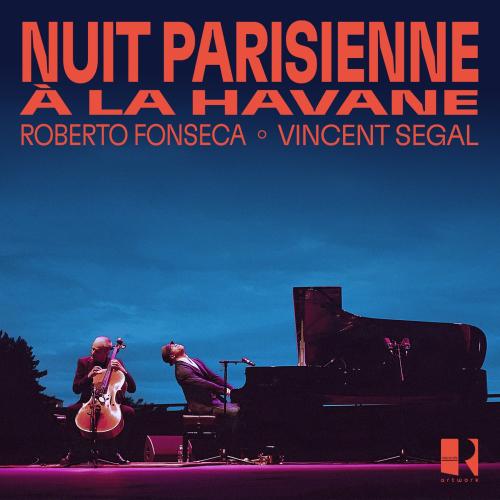
Nuit parisienne à La Havane Vincent Segal & Roberto Fonseca
Album info
Album-Release:
2026
HRA-Release:
30.01.2026
Label: Artwork Records
Genre: Jazz
Subgenre: Contemporary Jazz
Artist: Vincent Segal & Roberto Fonseca
Album including Album cover
- 1 Rumbo a Tí 02:38
- 2 Soul Kiss 04:10
- 3 Nuit Parisienne 04:36
- 4 Paciencia Es Lo Que Hay Que Tener 02:59
- 5 Un Homme Qui Dort 05:03
- 6 Day 04:30
- 7 Violoncelle Pointe Noire 00:51
- 8 Free 02:58
- 9 La Mar Quieta, Tú, Yo Pensando 04:59
- 10 Interlude Piano Silence Sound 00:55
- 11 Te Extraño (M.C.A) 06:11
Info for Nuit parisienne à La Havane
Acclaimed Cuban pianist Roberto Fonseca and renowned French cellist Vincent Segal join forces for the first time on Nuit Parisienne à la Havane. Both artists have built international careers by defying categories: Fonseca from his early years with the Buena Vista Social Club™ to collaborations with Herbie Hancock, Esperanza Spalding, Fatoumata Diawara, Baba Sissoko, Giles Peterson among others; Segal with projects ranging from Cesaria Evora to Ballaké Cissoko, Elvis Costello, Ibrahim Maalouf, Matthieu Chedid among others. This landmark duo recording is no exception, as Fonseca and Segal deliver an intimate, finely crafted encounter that bridges worlds.
Recorded spontaneously over five days, Nuit Parisienne à la Havane presents a captivating dialogue between piano and cello, balancing carefully composed material with moments of inspired improvisation. The album showcases the remarkable sensitivity, versatility, and adventurous curiosity of two master musicians known for moving freely between musical styles. In this inspiring set you can hear them diving into Cuban tradition while playing with classical forms, melodic improvisation, and exploring a number of modern sensibilities.
"I have a very strong influence from classical music, especially from Bach and Chopin," Fonseca explains. "The intention was to create a sound world where passion prevails and to share a sonority that may be new to many listeners, a tribute to the great composers of classical and universal music, but in an original way."
The album's title reflects Fonseca's deep connection with Paris, a city where he would love to live. For Segal, his Parisian night is "made of memories from the jazz clubs where, at 20, I would listen in the cellars to Alain Jean-Marie, Art Farmer, Chet Baker, Eddie Louiss… It's the smell of croissants, the Seine from Pont Marie with swans sleeping like icebergs, the cries of tipsy night owls, and then the first song of the blackbird."
The collaboration came naturally after years of knowing each other. "We had known each other for years, but had never really taken the time to get to know one another," Segal recalls. "Roberto suggested playing his composition 'Rumbo a Tí,' and we played it with great pleasure, we share a common musical culture."
What emerged is an album that evokes the early 20th century era when Spanish classical music and Cuban rhythms blended to create Danzón and Danzonete, while maintaining a contemporary edge. The recording required no preparation, the two artists simply sat down and began to play, creating what Fonseca describes as "several short films, each with its own story."
"Through atmospheres and melody, I simply try to take everyone who listens on a sonic journey," Fonseca says. "To make them feel a deep sense of spirituality linked to a strong desire to compose melodies that remain both in the mind and in the heart."
The album features singles "Rumbo a Tí," "Nuit Parisienne," and "Soul Kiss," each showcasing the profound communication between the two musicians. For Fonseca, every piece holds equal importance: "All the songs are my favorites. Each one tells a story… and all of them are part of my life. You can feel a very deep communication and connection between the two instruments."
Fonseca reserves special praise for his collaborator: "Above all, his human quality and kindness are so beautiful, and that's the reason his musical universe is so special. He has the gift of expressing and communicating in a unique and masterful way through his sound world."
Taking the listener through a variety of genres, from Cuban rhythms of various eras to French chanson, classical music, African rhythms, and Eastern inspirations, this album highlights these artists' skill to strip down every piece to its essence and bring to life their significance and meaning. Therefore, the album should be experienced in the spirit of a concert: close the door, take your time, and let yourself be carried away by the cathartic frequencies of this delicate and insightful dialogue.
Nuit Parisienne à la Havane is both a culmination of Roberto Fonseca's diverse musical journey and a testament to the power of spontaneous musical dialogue. The album arrives as a pure, spiritual, and emotional statement from two master musicians at the height of their creative powers.
Roberso Foncesca, piano
Vincent Segal, violoncelle
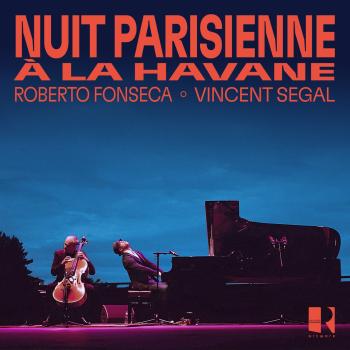
Vincent Segal & Roberto Fonseca
When Ballake Sissoko and Vincent Segal released their first collaborative album, Chamber Music, they caught the music world by surprise. Everything about this duo was unexpected: the Malian master of the traditional harp, or kora; the French cellist with the unlikely background in trip-hop; and the elegant, soulful music they made together. The album appeared on numerous best-of lists in both Europe (in 2009) and North America (in 2011). Now, these two sonic voyagers have returned with Musique de Nuit (“Night Music”) – an album which may not have the same element of surprise, but which may be even more spellbinding than its predecessor.
After years of touring together Sissoko and Segal have created their own hybrid tradition, one that draws on the ancient well of West African troubadour songs, the rich heritage of Baroque music, and an elusive but somehow clearly modern sensibility. Musique de Nuit refines their approach: where Chamber Music included several guests, most of this album consists solely of duets – though your ears may tell you different.
Much of this is due to Segal’s inventive cello playing, which can provide a percussive groove in the lilting opener “Niandou” or imitate the njarka, the Malian fiddle, in “Balazando.” The seamless way that he moves from one sound to another gives the illusion of several musicians playing at once. Sissoko, meanwhile, weaves a filigreed texture of sound from his kora, which is both a melodic and a rhythmic instrument. And while you’d never mistake this for a jazz album, it does share a spiritual kinship with the great album of duets made by Duke Ellington with bassist Jimmy Blanton, in the sense that it captures two musicians keenly listening to each other, and responding with an almost telepathic connection to each change of timbre or rhythm.
“It’s actually a bit husky, and raw,” Vincent Segal explains. “There are out-of-tune notes and fingernails crack sometimes, but there’s a sort of activity between us in those moments that I love.” The idea, he says, was not to try to re-create the sounds of a performance in a beautiful concert hall, but something much more personal and intimate; “I love listening to my musician friends at their places, in the studio between sessions, in the backstage area.”
Perhaps the most magical thing about Musique de Nuit is that after years of touring, and performing together on hundreds of stages around the world, the album has the feeling of eavesdropping on a late-night jam session. In fact, the album was recorded in two sessions in the Malian capitol of Bamako – one at night on Ballake’s rooftop, and the other during the day in the famed Bogolan studio. “We’ve always had this connection to the oral tradition,” Segal says, “and improvisation, and clarity of discourse.” Those deep roots give the album a timeless cast, as it moves between quietly beautiful nocturnes and lively, dance-based melodies.
This album contains no booklet.