






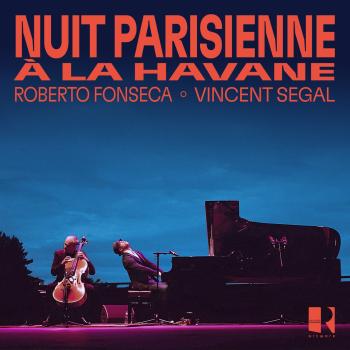
Vincent Segal & Roberto Fonseca
Biography Vincent Segal & Roberto Fonseca
Vincent Segal & Roberto Fonseca
When Ballake Sissoko and Vincent Segal released their first collaborative album, Chamber Music, they caught the music world by surprise. Everything about this duo was unexpected: the Malian master of the traditional harp, or kora; the French cellist with the unlikely background in trip-hop; and the elegant, soulful music they made together. The album appeared on numerous best-of lists in both Europe (in 2009) and North America (in 2011). Now, these two sonic voyagers have returned with Musique de Nuit (“Night Music”) – an album which may not have the same element of surprise, but which may be even more spellbinding than its predecessor.
After years of touring together Sissoko and Segal have created their own hybrid tradition, one that draws on the ancient well of West African troubadour songs, the rich heritage of Baroque music, and an elusive but somehow clearly modern sensibility. Musique de Nuit refines their approach: where Chamber Music included several guests, most of this album consists solely of duets – though your ears may tell you different.
Much of this is due to Segal’s inventive cello playing, which can provide a percussive groove in the lilting opener “Niandou” or imitate the njarka, the Malian fiddle, in “Balazando.” The seamless way that he moves from one sound to another gives the illusion of several musicians playing at once. Sissoko, meanwhile, weaves a filigreed texture of sound from his kora, which is both a melodic and a rhythmic instrument. And while you’d never mistake this for a jazz album, it does share a spiritual kinship with the great album of duets made by Duke Ellington with bassist Jimmy Blanton, in the sense that it captures two musicians keenly listening to each other, and responding with an almost telepathic connection to each change of timbre or rhythm.
“It’s actually a bit husky, and raw,” Vincent Segal explains. “There are out-of-tune notes and fingernails crack sometimes, but there’s a sort of activity between us in those moments that I love.” The idea, he says, was not to try to re-create the sounds of a performance in a beautiful concert hall, but something much more personal and intimate; “I love listening to my musician friends at their places, in the studio between sessions, in the backstage area.”
Perhaps the most magical thing about Musique de Nuit is that after years of touring, and performing together on hundreds of stages around the world, the album has the feeling of eavesdropping on a late-night jam session. In fact, the album was recorded in two sessions in the Malian capitol of Bamako – one at night on Ballake’s rooftop, and the other during the day in the famed Bogolan studio. “We’ve always had this connection to the oral tradition,” Segal says, “and improvisation, and clarity of discourse.” Those deep roots give the album a timeless cast, as it moves between quietly beautiful nocturnes and lively, dance-based melodies.