




Thad Jones, Frank Wess, Kenny Burrell, Mal Waldron
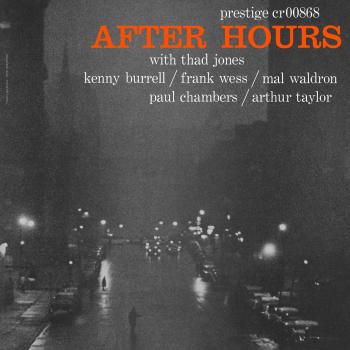
Biography Thad Jones, Frank Wess, Kenny Burrell, Mal Waldron
Thad Jones
A harmonically advanced trumpeter/cornetist with a distinctive sound, as well as a talented arranger/composer, Thad Jones (the younger brother of Hank and older brother of Elvin) had a very productive career. Self-taught on trumpet, he started playing professionally with Hank Jones and Sonny Stitt when he was 16. After serving in the military (1943-1946), Jones worked in territory bands in the Midwest. During 1950-1953 he performed regularly with Billy Mitchell’s quintet in Detroit and he made a few recordings with Charles Mingus (1954-1955). Jones became well-known during his long period (1954-1963) with Count Basie’s Orchestra, taking a “Pop Goes the Weasel” chorus on “April in Paris,” and sharing solo duties with Joe Newman. While with Basie, Jones had the opportunity to write some arrangements and he became a busy freelance writer after 1963. He joined the staff of CBS, co-led a quintet with Pepper Adams, and near the end of 1965, organized a big band with drummer Mel Lewis that from February 1966 on, played Monday nights at the Village Vanguard. During the next decade the orchestra (although always a part-time affair) became famous and gave Jones an outlet for his writing. He composed one standard (“A Child Is Born”) along with many fine pieces including “Fingers,” “Little Pixie,” and “Tiptoe.” Among the sidemen in the Thad Jones-Mel Lewis Orchestra (which started out as an all-star group and later on featured younger players) were trumpeters Bill Berry, Danny Stiles, Richard Williams, Marvin Stamm, Snooky Young, and Jon Faddis, trombonists Bob Brookmeyer, Jimmy Knepper, and Quentin Jackson, the reeds of Jerome Richardson, Jerry Dodgion, Eddie Daniels, Joe Farrell, Pepper Adams, and Billy Harper, pianists Hank Jones and Roland Hanna, and bassists Richard Davis and George Mraz. In 1978, Jones surprised Lewis by suddenly leaving the band and moving to Denmark, an action he never explained. He wrote for a radio orchestra and led his own group called Eclipse. In late 1984 Jones took over the leadership of the Count Basie Orchestra but within a year bad health forced him to retire. Thad Jones recorded as a leader for Debut (1954-1955), Blue Note, Period, United Artists, Roulette, Milestone, Solid State, Artists House, A&M, Metronome, and many of the Thad Jones-Mel Lewis Orchestra’s best recordings have been reissued on a five-CD Mosaic box set.
Frank Wess
Saxophonist and flutist. Born 1922 in Kansas City.
Wess was raised in Oklahoma, beginning to play alto saxophone at age 10. His family moved to Washington in 1935. His father was principal of a school and his mother was a music teacher. In Washington, Wess studied music theory with Henry Grant and played with Billy Taylor and other local musicians. He was graduated from Dunbar High School in 1937 and attended Howard University (1937-1938). Wess worked in the orchestras of Bill Baldwin and Tommy Myles and was a member of the Howard Theater band before he enlisted in the U.S. Army, serving from 1941 to 1945, primarily in North Africa, where he toured in support of Josephine Baker.
Following his discharge, Wess worked in the big band of Billy Eckstine (1946-1947). He returned to Washington and continued his musical studies at the Modern School of Music (1949-1953) where he focused on flute. After being courted by Count Basie for several years, he joined the Basie Orchestra in August 1953 and remained until 1964. Even early during his tenure, Wess was influential in recommending new musicians and helped to shape the sound of the band.
Malcolm Earl "Mal" Waldron
(August 16, 1925 – December 2, 2002) was an American jazz pianist, composer, and arranger. He started playing professionally in New York in 1950, after graduating from university. In the following dozen years or so Waldron led his own bands and played for those led by Charles Mingus, Jackie McLean, John Coltrane, and Eric Dolphy, among others. During Waldron's period as house pianist for Prestige Records in the late 1950s, he appeared on dozens of albums and composed for many of them, including writing his most famous song, "Soul Eyes", for Coltrane. Waldron was often an accompanist for vocalists, and was Billie Holiday's regular accompanist from April 1957 until her death in July 1959.
A breakdown caused by a drug overdose in 1963 left Waldron unable to play or remember any music; he regained his skills gradually, while redeveloping his speed of thought. He left the U.S. permanently in the mid-1960s, settled in Europe, and continued touring internationally until his death.
In his 50-year career, Waldron recorded more than 100 albums under his own name and more than 70 for other band leaders. He also wrote for modern ballet, and composed the scores of several feature films. As a pianist, Waldron's roots lay chiefly in the hard bop and post-bop genres of the New York club scene of the 1950s, but with time he gravitated more towards free jazz. He is known for his dissonant chord voicings and distinctive later playing style, which featured repetition of notes and motifs.
Kenny Burrell
has appeared on so many essential jazz recordings that jazz history and his biography seem irretrievably intertwined. Billie Holiday's valedictory rumination Lady Sings the Blues, Jimmy Smith's epochal funk throwdown Back at the Chicken Shack, Tony Bennett's Carnegie Hall debut — Kenny Burrell played guitar for them all. Even Jimi Hendrix once remarked, "Kenny Burrell — that's the sound I'm looking for." Here is Burrell captured live at the West-Coast jazz mecca, Catalina's, in an easy-going program of some of his most-requested tunes along with a few of his personal favorites thrown in. Jazz tunes by Benny Golson, Freddie Hubbard, the Duke and others, standards and even Kenny's classic original"Chitlins Con Carne" are here, all given the ever-tasteful Burrell treatment.
Paul Chambers
One of the top bassists of 1955-1965, Paul Chambers grew up in Detroit where he was part of the fertile local jazz scene. After touring with Paul Quinichette, Chambers went to New York, where he played with the J.J. Johnson-Kai Winding quintet and George Wallington. He spent the bulk of his prime years as a member of the Miles Davis Quintet participating in virtually all of Davis’ classic recordings of the era. When he left, “Mr. P.C.” (as John Coltrane called him in one of his originals) worked with the Wynton Kelly Trio (1963-1966) and freelanced. Chambers, a consistently inspired accompanist who was an excellent soloist, made many recordings during his too-brief career including some with Coltrane, Sonny Rollins, Cannonball Adderley, Donald Byrd, Bud Powell, and Freddie Hubbard, in addition to several as a leader including his excellent Blue Note albums Whims of Chambers, Bass On Top, and Paul Chambers Quintet.
Art Taylor
One of the great drummers of the 1950s, Art Taylor was on a countless number of hard bop and jam session-styled sessions. His first important gig was with Howard McGhee in 1948, and this was followed by associations with Coleman Hawkins (1950-1951), Buddy DeFranco (1952), Bud Powell (1953 and 1955-1957), and George Wallington (1954-1956). Taylor seemed to live in Prestige’s studios during the second half of the 1950s, although he found time to lead his Wailers, visit Europe with Donald Byrd in 1958, gig and record with Miles Davis, and play with Thelonious Monk (including his acclaimed Town Hall concert) in 1959. In 1963, Taylor moved to Europe where he spent most of the next 20 years (mostly living in France and Belgium), playing with Europeans and such Americans as Dexter Gordon and Johnny Griffin. He interviewed scores of his colleagues and collected many of the insightful discussions in his very readable book Notes and Tones (which was reprinted in 1993). After returning to the U.S., Taylor resumed his freelancing, and in the early ’90s he organized a new version of the Wailers which, during its short existence prior to his death, temporarily filled the gap left by the end of the Jazz Messengers.