




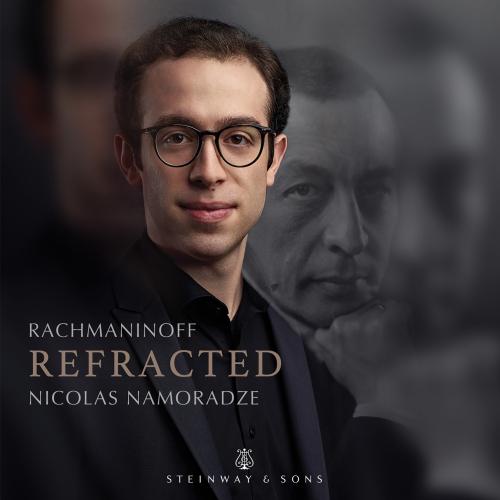
Rachmaninoff, Refracted Nicolas Namoradze
Album info
Album-Release:
2023
HRA-Release:
01.11.2023
Label: Steinway and Sons
Genre: Classical
Subgenre: Instrumental
Artist: Nicolas Namoradze
Composer: Sergei Rachmaninoff (1873-1934)
Album including Album cover Booklet (PDF)
This Album is available for streaming only.
Thank you for your interest in this album. It is available for streaming only.
Get a streaming subscription to listen to this album.
- Johann Sebastian Bach (1685 - 1750): Violin Partita No. 3 in E Major, BWV 1006:
- 1 Bach: Violin Partita No. 3 in E Major, BWV 1006: III. Gavotte en rondeau (Arr. for Piano by Sergei Rachmaninoff) 03:11
- Sergei Rachmaninoff (1873 - 1943): Symphony No. 2 in E Minor, Op. 27:
- 2 Rachmaninoff: Symphony No. 2 in E Minor, Op. 27: III. Adagio (Arr. for Piano by Nicolas Namoradze) 13:25
- 14 Romances, Op. 34:
- 3 Rachmaninoff: 14 Romances, Op. 34: No. 14, Vocalise (Arr. for Piano by Zoltán Kocsis) 07:52
- Piano Sonata No. 1 in D Minor, Op. 28:
- 4 Rachmaninoff: Piano Sonata No. 1 in D Minor, Op. 28: I. Allegro moderato 13:39
- 5 Rachmaninoff: Piano Sonata No. 1 in D Minor, Op. 28: II. Lento 08:11
- 6 Rachmaninoff: Piano Sonata No. 1 in D Minor, Op. 28: III. Allegro molto 16:12
- Nicolas Namoradze (b. 1992): Memories of Rachmaninoff’s Georgian Song
- 7 Namoradze: Memories of Rachmaninoff’s Georgian Song 05:03
Info for Rachmaninoff, Refracted
Pianist and composer Nicolas Namoradze’s new album, Rachmaninoff Refracted, explores the oeuvre of Sergei Rachmaninoff on the occasion of his 150th anniversary year. Namoradze approaches his work from several angles: as a pianist, composer, transcriber, and one whose music is arranged.
In his liner notes for the album Namoradze writes: Rachmaninoff’s monumental Piano Sonata No. 1 constitutes the program’s center of gravity, and is complimented by one of his most celebrated transcriptions, as well as a set of recent arrangements and reflections on his work—a testament not only to the continued centrality of his musical output in the core repertory but also the freshness of his oeuvre and the new forms and guises in which it appears today.
Opening the album is Rachmaninoff’s iconic arrangement of the Gavotte from the Third Partita for Solo Violin by Johann Sebastian Bach (1685-1750). The Gavotte is one of three movements that Rachmaninoff transcribed in 1933, along with the Preludio and Gigue. In the sprightly, elegant Gavotte, rather than simply realizing Bach’s string writing on the keyboard Rachmaninoff adds several polyphonic layers, yielding not only considerably denser textures but also a plethora of new harmonic motions. This complexity reflects his fascination with the counterpoint of Bach—a significant influence on Rachmaninoff’s piano writing.
The next work on the program is my arrangement for solo piano of the Adagio from Rachmaninoff’s Symphony No. 2 in E minor, Op. 27. Since its highly successful premiere in 1908 the symphony remains among Rachmaninoff’s most celebrated musical statements, and the third movement, Adagio, is emblematic of many features that define his compositional language, including enchantingly expansive melodies, a rich harmonic palette, searing climaxes, and lush, full textures. While adhering strictly to the thematic and harmonic material of the original, this arrangement is less a strict transcription and more a reimagining of the movement for the piano, taking a generally liberal approach with reworking the textures in order to create a pianistically idiomatic piece. The piano writing is informed both by Rachmaninoff’s compositional style as well as my own approach to keyboard texture.
Another arrangement of Rachmaninoff’s work follows: the Vocalise, Op. 34 No. 14, transcribed for solo piano by Zoltán Kocsis (1952-2016). Among Rachmaninoff’s most widely performed songs, the Vocalise is something of an anomaly given its lack of text (as suggested by its title), with the singer vocalizing a sorrowful, haunting vocal line. This feature has also made the song especially amenable to arrangements, with multiple versions in existence for a variety of instrumentations. Kocsis’s solo piano transcription remains generally faithful to the original texture until the final reprise of the opening material, which is adorned by crystalline, gently fluttering arabesques in the upper registers of the keyboard.
The Vocalise makes way for the centerpiece of the disc, Rachmaninoff’s Piano Sonata No. 1 in D minor, Op. 28. Completed in 1907, it is his most symphonic creation for the piano, and closest in spirit to another work he was writing during this period—the Symphony No. 2. Despite several revisions and attempts on the part of the composer to condense the work, the sonata remains colossal in scale and breadth—reflecting his original programmatic conception of the piece, based on the epic of Faust. According to accounts of his contemporaries, Rachmaninoff had intended the three movements to depict Faust, Gretchen and Mephistopheles in turn, thus taking after Liszt’s Faust Symphony and the Sonata in B minor. The brooding opening of the first movement makes way for a variety of thematic material at times agitated and anguished, at times resolute and valiant, alternating in a heroic struggle. The lyrical second movement, with its soaring melodies and beguilingly rich textures, provides some respite before the diabolical finale: a macabre tempest suffused with strains of the Dies Irae chant which, despite a number of attempts to emerge from the depths with references to the previous movements, ends cataclysmically.
I wrote Memories of Rachmaninoff’s Georgian Song, the final work on the album, for the sesquicentennial celebrations. It is based on an early song by Rachmaninoff, Oh, do not sing for me, Op. 4 No. 4, set to a poem by Pushkin and known as the “Georgian Song.” The song’s expressively winding and melismatic opening, highly reminiscent of Georgian folk music yet an original creation of Rachmaninoff’s, introduces the following verse:
Do not sing for me, my beauty,
Your sad Georgian songs of yore;
For they wake deep from my memory
Another life and a distant shore.
Memories of Rachmaninoff’s Georgian Song is neither an arrangement nor a paraphrase, but rather the musical equivalent of a faint, dreamlike recollection—an allusion to the topic of the original song itself. The work opens with a sparse figuration where strains of the song’s melody are occasionally suggested, as if from far away. A gradual thickening of the texture leads to a more recognizable utterance of Rachmaninoff’s thematic material before the work retreats back into the realm of distant memory. (Nicolas Namoradze)
Nicolas Namoradze, piano
Nicolas Namoradze
is a visionary pianist and composer known for his innovative artistry. He came to international attention in 2018 upon winning the triennial Honens International Piano Competition in Calgary, Canada, and has since garnered international acclaim for his performances and recordings. A Musical America New Artist, BBC Music Magazine Rising Star and Gramophone One to Watch, he was bestowed the Pianist of the Year Award by the UK Critics’ Circle in 2022. His often sold-out recitals around the globe have been met with critical praise, and album releases have received extraordinary accolades, including the Choc de Classica, Record of the Month in Limelight, Instrumental Disc of the Month in BBC Music Magazine, Editor’s Choice in Gramophone, Editor’s Choice in Presto Classical and Critics’ Choice in International Piano, as well as a first-place debut in the UK charts for classical instrumental albums. An exclusive Ondine recording artist, his first album with the label, released in October 2026, is an all-Beethoven album featuring the Hammerklavier Sonata and his own solo piano arrangement of the Grosse Fuge.
The 2026/27 season takes him across North America, Europe and further afield with highlights including a series of recitals at the Konzerthaus Dortmund, recitals at London’s Wigmore Hall, Munich’s Prinzregententheater, Padova’s Palazzo Livano and the Vancouver Annex, highly anticipated returns to Japan and Taiwan for solo recital tours including performances at Tokyo’s Triphony Hall and Taipei’s National Concert Hall, and residencies at the Banff Centre and the Sarasota, Honens and Tonebase Festivals. Orchestral highlights include a Saint-Saëns concerto recording project, with a performance at New York’s Alice Tully Hall. He presents his groundbreaking “Neurorecital” at the Cristofori and Beakerhead Festivals, a project which has garnered extensive coverage including features in the New York Times, Financial Times, BBC Music Magazine, Classic FM, and Radio Classique. The season also sees several major composition premieres, including a co-commission by Wigmore Hall and the BBC premiering at the Wigmore, a Schnabel Foundation commission appearing on a new album on the Sono Luminus label, and the compulsory commissioned work for the Tbilisi International Piano Competition, where he also serves on the jury.
Previous seasons have included acclaimed performances of Brahms’ Piano Concerto No. 2 with Iván Fischer and the Budapest Festival Orchestra, whose broadcast medici.tv included as one of nine all-time greatest performances by former piano competition winners in a “prizewinner to pantheon” lineup and named him among thirty-five pianists in their list of “history’s most celebrated pianists.” Recent acclaim includes five-star reviews in The Telegraph and The Guardian, which described his Royal Festival Hall performance as “ideally laconic and debonair, weighty yet exquisite, and exactingly precise in tone and touch,” while International Piano hailed his Wigmore Hall recital as “unfolding in an opalescent glow, every bar touched with beauty… exultant and never less than technically immaculate.” Additional highlights include residencies with the Antwerp Symphony Orchestra, Verbier Festival, and Dresdner Philharmonie, recitals at major venues such as Carnegie Hall, Konzerthaus Berlin, Tokyo Bunka Kaikan, and Boston’s Gardner Museum, and concerto performances with the London Philharmonic, Sinfonieorchester Basel, Calgary Philharmonic, Milwaukee Symphony, RAI Symphony Orchestra and the National Symphony Orchestra of Ireland, under conductors including Karina Canellakis, Hans Graf, Jeffrey Kahane, Ken-David Masur, and Daniele Rustioni.
As a composer, Namoradze has received commissions and performances from esteemed artists, ensembles, and festivals including the Chelsea Music Festival, Portland Piano International, Klavier-Festival Ruhr and the Santa Fe Chamber Music Festival, with several album releases on the Steinway & Sons label. He has also scored several film soundtracks, such as Le chant des étoiles, and his works are published by Muse Press. Namoradze is also involved in new directions in performance and audience engagement, informed by his involvement in music-related fields in the cognitive sciences. His doctoral thesis at the CUNY Graduate Center developed mathematical models for aspects of musical perception, winning the Barry Brook Award for dissertation of the year. It is now published by Springer as the book “Ligeti’s Macroharmonies” in the Computational Music Science series. Namoradze presents recital formats that reimagine the concert experience through a range of innovative projects, including lecture-recitals, immersive multimedia performances, and interdisciplinary collaborations with scientific research.
Born in Tbilisi, Georgia and raised in Budapest, Namoradze studied in Budapest, Vienna, Florence, New York and London with mentors including Emanuel Ax, Yoheved Kaplinsky, Zoltán Kocsis, Matti Raekallio, András Schiff and Eliso Virsaladze in piano, and John Corigliano in composition. He now serves on the faculty of the CUNY Graduate Center and deputizes at The Juilliard School.
Booklet for Rachmaninoff, Refracted