



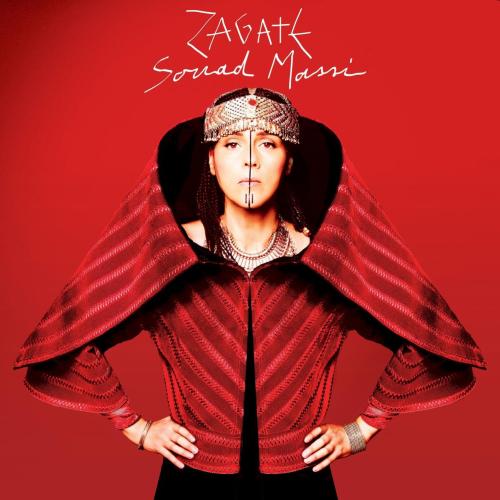
Zagate Souad Massi
Album info
Album-Release:
2026
HRA-Release:
06.03.2026
Album including Album cover
I`m sorry!
Dear HIGHRESAUDIO Visitor,
due to territorial constraints and also different releases dates in each country you currently can`t purchase this album. We are updating our release dates twice a week. So, please feel free to check from time-to-time, if the album is available for your country.
We suggest, that you bookmark the album and use our Short List function.
Thank you for your understanding and patience.
Yours sincerely, HIGHRESAUDIO
- 1 Samt 03:29
- 2 D'ici, De là-bas 02:55
- 3 Zagate 03:32
- 4 L'équation #1 01:48
- 5 L'équation #2 03:07
- 6 Tiri 04:16
- 7 Congo Connection 03:42
- 8 Ana Inssan 03:48
- 9 Sawt 03:57
- 10 Chibani 04:05
- 11 6 heures du matin 03:35
Info for Zagate
Somewhere between folk, rock and poetry, Souad Massi is back with Zagate, a dazzling album in which the softness of her vocals stands in stark contrast with the weight of today’s world. The emotional force and lyrical clarity present throughout this eleven-track album makes it the most liberated and outspoken work in the French-Algerian artist’s career.
Zagate - a word derived from the French expression “ça se gâte”, which is used in Algeria to announce that “things are getting worse”. In choosing this title for her new album, Souad Massi makes more than a linguistic reference. With this one word she affirms her dual heritage, between Algeria, where she was born; and France, where she has been living and creating music for the past twenty-six years. This double expression opens the way for an intense album, more rock, more audacious than ever, without betraying the fragility she has become known for.
Souad Massi, although reluctant to describe herself as politically active - “I prefer to keep that word for those who are out in the field” - offers us an unflinching, frank reflection on the troubled aspects of our world: war, violence, racism and the tragedies which flood our screens and weigh on our consciences. “I find it difficult not to be affected by all the information we are constantly being bombarded with”, she confides. “In this album, I wanted to share my own vision of the world”. More than a vision, Zagate reveals a real, or even a raw sensitivity. We discover the artist in a freer, more direct form of expression: “I am not the same as when I began my career. For a long time I struggled to overcome my shyness and fear of expressing myself. Today I have the confidence and maturity to speak my mind”.
Helmed by English guitarist and producer Justin Adams - already present on the album Sequana (2022) - the eleven tracks on Zagate, recorded predominantly in England, explore a range of emotions of a rare intensity: pain, anger and revolt, but also hope and courage. From the electric rock of Ana Inssan to the bewitching Afrobeat of Samt, or from the Saharan folk of D’ici, De là-bas to the Parisian blues of Chibani, each track reveals new vocal nuances. Long associated with gentleness and melancholy, Souad Massi steps out here in all of her diversity, more whole and more authentic than ever.
To reach this level of accomplishment, she had to summon all the layers of her own history. Born in Bab-El-Oued, a working class, culturally mixed district of Alger, she grew up surrounded by strong women, in a world dominated by men. This childhood forged within her the conviction that independence was the path to salvation. She went on to become a civil engineer, only to rapidly discover that professional success alone cannot free us from our personal shackles. And so she chose music. With the support of her music-loving parents and a pianist brother, she studied classical guitar, wrote poetry, read philosophy and discovered the likes of Oum Kalthoum, Amália Rodrigues, Joan Baez, Bob Dylan and Led Zeppelin. “When I heard Kashmir for the first time, it gave me goose pimples. It felt like this western music I admired was finally inviting me in.”
Lead singer of the rock group Atakor, in the late 1990’s she travelled across Algeria amid the “Black Decade”, a period of intense fear and violence. Then, in 1999, an invitation to Paris changed her life: she recorded Raoui, her first album, which went gold in France. In her following album, Deb, she affirmed her folk style, inspired by the singer Idir. Mesk Elil won a Victoire de la Musique (French Grammy) award and earned the artist the image of a bitter-sweet voice of exile.
However, with Zagate, Souad Massi breaks the mould; she electrifies her lyrics and lays bare both her anger and her hopes. “The gravity of our time pushed me to step out of the gentler, more melancholic musical forms I became known for.”
“How could I pretend nothing was wrong?” she seems to be saying. With rappers Youssoupha (Congo Connection) and Gaël Faye (D’ici, De là-bas) by her side, she offers us an album which is both intimate and political, in which her poetry becomes an act of resistance in itself. Here is a mirror-album, by an artist more liberated in her expression and more in touch with the world than ever.
Souad Massi
Souad Massi
Often considered the most beautiful female voice of North Africa, Souad Massi has forged her reputation over the course of a career spanning more than 20 years. Driven by an unfailing determination to speak out for what she values most: freedom and justice, her songs are steeped in love, altruism and bravery, with a constant will to eradicate intolerance. It has been said that she is the Tracy Chapman of the Maghreb. Far from the breaking wave of raï, Souad Massi, with her folk inspiration, guitar slung over her shoulder, brought a new sound to Algerian music.
Born in the 1970s into a modest family in Algiers, Souad Massi discovered music at a very young age. From the outset her music was one of encounters, contrasts and cultural blending, as she studied what we name “classical” music alongside Arab-Andalusian music. Onto these two demanding genres she grafted her own influences: blues, folk and rock. Souad Massi moves easily from one style to another, playing in the early 90s with the flamenco group Triana from Algiers and at the end of the decade with the hard rock group Atakor. Souad Massi released her first solo cassette in 1998. Writing her own lyrics and music, she attracted much attention during the “Femmes d’Algérie” festival in Paris in January 1999; to such a degree that she was signed by the Universal Music label Island-Mercury, who produced her first album.
This album contains no booklet.