







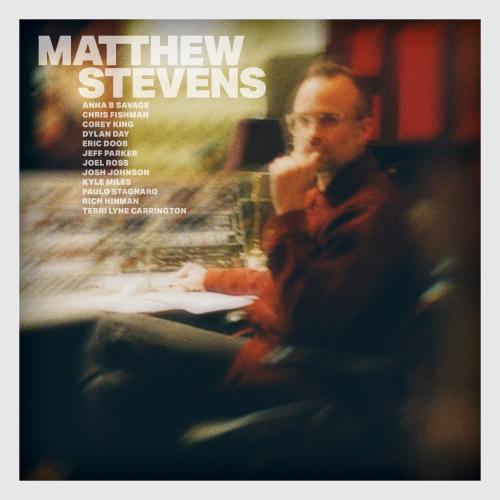
Matthew Stevens Matthew Stevens
Album info
Album-Release:
2026
HRA-Release:
08.05.2026
Album including Album cover
- 1 Take Heart 05:51
- 2 Hazy (Intro) (48 kHz) 00:54
- 3 Hazy (48 kHz) 04:58
- 4 SLMS 03:19
- 5 1000 Times 04:33
- 6 Edgewood 03:30
- 7 Who Does She Hope to Be? 05:53
- 8 Born of Silence 06:51
- 9 Alberta (48 kHz) 04:18
- 10 The air is thick 04:46
Info for Matthew Stevens
Matthew Stevens gathers a multigenerational lineup, spanning mentors like Terri Lyne Carrington, guitarists such as Jeff Parker, and contemporary voices including Joel Ross, Anna B Savage, and Corey King.
Matthew Stevens arrives at a moment of rare clarity on his new self-titled album, the kind of release that comes well into a career and signals purpose rather than reinvention. It captures a guitarist who has settled into his voice and sharpened his instincts, drawing together years of work as a bandleader, collaborator, and producer into a single, focused statement.
For Stevens, the decision to name the album after himself was straightforward. He describes it as the first time he has felt fully aligned with his artistic identity, and the music reflects that confidence. Acoustic and electric guitars move fluidly across genre lines, originals sit comfortably alongside carefully chosen covers, and the performances feel guided by intention rather than display.
The cast of collaborators mirrors Stevens’ journey. Longtime mentors like Terri Lyne Carrington appear alongside peers and younger voices shaping the current moment. Guitar hero Jeff Parker, vibraphonist Joel Ross, and vocalists Anna B Savage and Corey King all bring distinct perspectives. At the center is Stevens’ core band: saxophonist Josh Johnson, keyboardist Chris Fishman, bassist Kyle Miles, and drummer-percussionist Eric Doob, each contributing with sensitivity and restraint. Additional textures come from percussionist Paulo Stagnaro, guitarist Dylan Day on slide, and Rich Hinman on pedal steel.
Stevens chose Johnson and Doob as co-producers, valuing a shared sense of priorities in the studio. The sessions unfolded as an open conversation rather than a hierarchy, with engineer Kyle Hoffmann capturing the performances at NRG Studios in Los Angeles with clarity and depth. The result is a record that feels deliberate without sounding overworked.
The album also reflects a period of significant personal change. Stevens relocated from New York City to the Boston area to teach at Berklee College of Music, remarried, and produced I Am a Pilgrim, his centennial tribute to Doc Watson. That project brought together artists like Jerry Douglas, Steve Earle, Rosanne Cash, Valerie June, and Bill Frisell, and earned a Grammy nomination for a new recording of Dolly Parton’s “The Last Thing on My Mind.” Stevens already held multiple nominations and a Grammy win for his work on Carrington’s New Standards Vol. 1, but the Watson project deepened his confidence as a producer and clarified his values.
Those lessons carry directly into Matthew Stevens. The album draws from the improvisational interplay of Woodwork, the studio experimentation of Preverbal, and the melodic focus of his solo acoustic album Pittsburgh. What emerges is music that values feel and form equally, aiming for moments that feel both surprising and inevitable.
Matthew Stevens arrives as a summation without feeling retrospective. It documents an artist shaped by collaboration, life changes, and hard-earned perspective, playing with assurance and generosity. The music invites contemplation, but it also carries a quiet optimism, grounded in the sense that Stevens knows exactly where he stands and where he wants to go next.
Matthew Stevens, guitar
Jeff Parker, guitar
Terri Lyne Carrington, drums
Anna B Savage, vocals
Joel Ross, vibraphone
Corey King,keyboards
Please Note: This album consists of different sampling rates. See track list - behind each track you'll find the sampling rate.
Matthew Stevens
When an artist releases a self-titled album well into a successful recording career, it’s often seen as a declaration of purpose or a reaffirmation of principles. Matthew Stevens, out May 8 on Candid Records, is a midcareer mission statement by one of the most thrilling and thoughtful guitarists of his generation, playing and writing at the peak of his powers. “I have never been more in touch with myself artistically, which is why this album is self-titled,” says the guitarist. Matthew Stevens seamlessly melds acoustic and electric sonics, flows through genre-blurring original music and meaningful covers, and features a multigenerational cast of musicians who’ve had a profound impact on the artist’s journey.
The lineup includes mentors like Terri Lyne Carrington, personal guitar heroes like Jeff Parker, best-of-generation improvisers like the vibraphonist Joel Ross, and the vocal luminaries Anna B Savage and Corey King. At the album’s core is a band of Stevens’ most trusted collaborators, each of them a strikingly unique voice on his instrument: saxophonist Josh Johnson, keyboardist Chris Fishman, bassist Kyle Miles and drummer-percussionist Eric Doob. Other inspired contributions come from percussionist Paulo Stagnaro and guitarists Dylan Day and Rich Hinman on slide and pedal steel, respectively.
In Josh Johnson and Anna B Savage, Stevens has chosen two rising visionaries whose careers have been nothing short of thrilling to witness. In addition to collaborating with alt-jazz champions like Jeff Parker and releasing his own evocative LPs, Johnson has produced records including Meshell Ndegeocello’s Grammy-winning The Omnichord Real Book and Flea’s upcoming solo debut. He’s also a member of the innovative L.A. collective SML — “a dazzling studio jazz band that’s never actually been in a studio,” per the New York Times.
Savage, who was born in England and is now based in Ireland, is quickly earning a reputation as a beacon for a new generation of folksingers. Onstage, opening for the likes of St. Vincent, or on albums including 2025’s acclaimed You & i are Earth, she stuns listeners with the beauty and power of her storytelling — “[mining] complicated feelings with dark humor and an unforgettable voice,” says Rolling Stone.
For Matthew Stevens, the guitarist handpicked Johnson and Eric Doob as his co-producers. “As I followed Josh’s work over the years,” says Stevens, “it became clear that we had a shared sense of what was important to us in music.” The sessions were an example of pure professional harmony. “Our workflow in the studio was just an easy, open and ongoing conversation between the three of us,” says Stevens. “Essentially, I think it was just a sense of shared responsibility to make the best record we could.” Engineer Kyle Hoffmann, who captured the sessions with clarity and ingenuity at NRG Studios in Los Angeles, was equally integral.
While it wouldn’t be quite correct to say that Matthew Stevens was a lifetime in the making, it most certainly is the album of his life. “This record is in many ways the culmination of 20 years of working as a professional musician — supporting other people as a player, producing records, putting out three of my own albums, and working in lots of different pockets of music,” Stevens says. That experience includes work as a key collaborator to visionaries like Carrington, Esperanza Spalding, Chief Xian aTunde Adjuah and Jamire Williams.
Matthew Stevens also reflects those transformative years between young adulthood and early middle age, when triumphs and challenges alike can trigger intense self-reflection. (He notes, with a chuckle, that this is his first record where he’s employed musicians younger than himself.) There had been, Stevens explains, some “huge life changes” leading up to the sessions. To start, Stevens has in recent years moved from New York City to the Boston area, for a teaching gig at the prestigious Berklee College of Music. He also remarried and produced I Am a Pilgrim, a lauded centennial tribute to roots icon Doc Watson.
That project featured a who’s who of original American voices, from Jerry Douglas, Steve Earle and Chris Eldridge to Rosanne Cash, Valerie June and Bill Frisell. One of the tracks, a new recording of “The Last Thing on My Mind” by Dolly Parton, earned a Grammy nomination — a fine addition to Stevens’ own three nominations and one Grammy win, the latter for Carrington’s New Standards Vol. 1.
Stevens’ production work, especially the Doc Watson project, has boosted his confidence and firmed up his artistic values. “I felt able to identify what was central — the core of the song and the feeling it emits,” he says. “If that is intact, there is an abundance of room for stylistic variation in how it is delivered. I find myself most excited by music that simultaneously feels surprising and inevitable, and that’s what I strive for in my own work.” Matthew Stevens bears out that desire.
What’s more, the album melds all the lessons Stevens absorbed in the writing and recording of his previous three records. It alchemizes the high-level improvisation and interplay of Woodwork (2015); the studio-centric sonic explorations of Preverbal (2017); and the heartfelt focus on songcraft and melody that defines Pittsburgh (2021), Stevens’ solo-acoustic outing. Put another way, this is work that delivers on all fronts — an act of striking musicianship that is also remarkably moving.
The kinetic “Take Heart,” featuring Joel Ross, offers up globally-tinged grooves and compelling conversation. The track boasts the deeply singular phrasing that has made Stevens one of his generation’s definitive guitar voices. Or, as the New York Times put it, “Stevens plays the guitar with tight clutch, improvising in truncated melodies and tense, frequently beautiful harmonies that always tilt toward a payoff.”
“Alberta,” the folk-blues standard associated with Lead Belly, is given a meditative, musing, even spiritual reading. The arrangement is spare — just Stevens’ acoustic guitar, Johnson’s alto sax, some swirling, elegant electronic textures and the divine voice of Anna B Savage. “I wanted Anna to sing this as soon as I decided to record the song,” says Stevens. “It’s a song that evokes a deep longing every time I hear or play it.”
“Born of Silence” relies on a simple, beautiful melody that cycles into your memory, elevated by dialogue within the band that is empathic and intuitive. The collective performance here is stunning — and indicative of Stevens’ passion for both jazz and Americana. The rapport reflects jazz-quality rigor along with the playful spirit of brilliant roots improvisers like the Grateful Dead or Bob Dylan’s best working bands. “I almost titled the album ‘Born of Silence,’” says Stevens. “I feel able to relate to this song as though I didn’t write it. It feels to me like the song you can put on during a long drive that serves as the backdrop to go wherever you want in your internal world.”
In fact, all of Matthew Stevens has that ability to invite contemplation and introspection — from the drifting, soulful take on Sonny Sharrock’s “Who Does She Hope to Be?” featuring Jeff Parker, to the neo-soul gait of “The air is thick.” “I wrote and recorded this album following a period of profound change, with some of my best friends who got me through that period,” Stevens says. “This music has brought me to where I am now — a place of optimism, excitement and confidence that I’ve never known before.”
This album contains no booklet.