




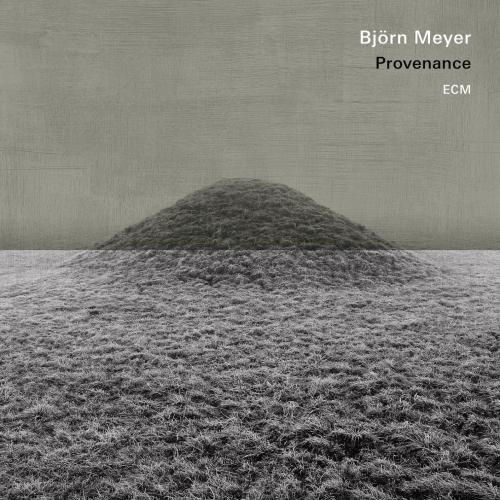
Provenance Björn Meyer
Album info
Album-Release:
2017
HRA-Release:
15.09.2017
Album including Album cover Booklet (PDF)
I`m sorry!
Dear HIGHRESAUDIO Visitor,
due to territorial constraints and also different releases dates in each country you currently can`t purchase this album. We are updating our release dates twice a week. So, please feel free to check from time-to-time, if the album is available for your country.
We suggest, that you bookmark the album and use our Short List function.
Thank you for your understanding and patience.
Yours sincerely, HIGHRESAUDIO
- 1 Aldebaran 04:29
- 2 Provenance 06:11
- 3 Three Thirteen 03:13
- 4 Squizzle 02:23
- 5 Trails Crossing 06:44
- 6 Traces Of A Song 03:50
- 7 Pendulum 05:50
- 8 Banyan Waltz 05:37
- 9 Pulse 04:27
- 10 Dance 04:52
- 11 Garden Of Silence 05:46
- 12 Merry-Go-Round 03:44
Info for Provenance
There is a distinguished tradition of albums devoted to solo bass on ECM, but Provenance is the first to showcase the electric bass guitar. Björn Meyer, born in Sweden and long based in Switzerland, has shaped a distinctive voice on his instrument within diverse contexts. He has worked alongside Persian harpist-singer Asita Hamidi, Swedish nyckelharpa player Johan Hedin and Tunisian oud master Anouar Brahem; and for a decade, Meyer was a member of Nik Bärtsch’s Ronin, in which his throbbing bass guitar was often a lead instrument. Meyer’s solo work explores the sound of the bass in acoustic space, as he points out in his booklet essay for the new album: “Even though the instrument is technically non-acoustic, the music is deeply influenced by the properties of the space where it is played. The many different ways in which acoustics affect my compositions and improvisations have always been sources of surprise and inspiration. There is definitely a second member in this solo project – the room!” The room for Provenance was the highly responsive Auditorio Stelio Molo RSI in Lugano, the Swiss radio studio’s rich acoustics helping to bring out all the detail in Meyer’s atmospheric solo creations.
Meyer has taken his bass guitar into realms in which electronic instruments rarely figure, as in his collaborations with musicians steeped in the acoustic traditions of their countries. Working with Hedin, Hamidi and Brahem gave Meyer “many reasons to re-think the function of my instrument but also to invent new ways of adding sounds and extending its tonal range,” he says. The bassist appears on two of Brahem’s recent, widely acclaimed albums on ECM: Souvenance (2015) and The Astounding Eyes of Rita (2009), with The Guardian praising “the contemporary edge” Meyer added to the Tunisian’s music.
In the electro-acoustic “Zen-funk” of Ronin — where rhythmic inspirations from Steve Reich to James Brown come together, along with influences from Japanese theater and music — Meyer’s drive and subtlety were key, his sound integral to the sonic momentum of the ECM albums Stoa (2006), Holon (2008), Llyría (2010) and Live (2012). An expert testimonial to Meyer’s instrumental prowess has come from his successor in Ronin, Swiss bassist Thomy Jordi. He said: “Björn is one of the few bass players in the world to have developed a unique style on the instrument. His concepts of sound and technique are highly personal... In his music, he seems to integrate many sources of traditional music, creating a beautiful, spiritual, modern world language.”
In his booklet essay for Provenance, Meyer recounts that in preparing for solo performances over the past few years he would follow a ritual starting 27 days before a concert, one that included recording whatever he was working on: improvisations, experiments, practicing, actual compositions, or various combinations of those. “At some point during each day, I would cut out exactly 60 seconds of music and release it on the internet as a kind of countdown or diary of ideas,” he writes. “When I started preparing for this album, there were already more than 150 such fragments... I made it a mission to revisit most of the fragments and see what kind of program they would evoke. Arriving in the studio, I had a clear picture of what material I wanted to use — but I hadn’t anticipated how strongly the room would affect the music. Lugano Radio Studio is a fantastic sounding room, and it opened up for a few improvisations and a fully new piece written in the night between the recording days, in spite of the blues festival echoing in the streets of Lugano...”
Provenance ranges from the hushed, guitar-like title track and similarly voiced “Pendulum” to the Ronin-like rhythmic minimalism of “Dance,” from the pensive tunefulness of “Banyan Waltz” and “Three Thirteen” to his textured interpretation of Hamidi’s entrancing “Garden Of Silence.” There’s also room for the virtuoso strummed funk of “Squizzle.” In the booklet, Meyer writes about his concept for capturing the sonic potential of the electric bass guitar on record, referencing his work in the studio with ECM producer Manfred Eicher and the engineer Stefano Amerio: “Very often when recording electric bass guitar, the fragile sounds of the actual instrument, such as the touching of strings, tend to get forgotten or deliberately left out — yet they inspire me in the search for new sonorities and playing techniques. With this recording, I wanted to share an alternative experience of the instrument, the way I hear it. I am very grateful that Manfred supported this approach and that Stefano managed to capture the dream behind the idea in the most beautiful way.”
Björn Meyer, electric bass, double bass
Björn Meyer
Born in Sweden and based in Switzerland since 1996, Björn Meyer is acclaimed for his category-defying musicianship, expanding the sonic and expressive possibilities of the electric bass. His pivotal ECM solo album Provenance (2017), produced by Manfred Eicher, reimagines the instrument in dialogue with acoustic spaces — what Meyer describes as a “second member” in his solo performances. The album has taken him to audiences worldwide, from the Elbphilharmonie in Hamburg and Ronnie Scott’s in London to Istanbul, Yokohama, Tehran, and beyond.
“.. Meyer has taken a unique approach to composition for solo bass guitar. It is one that will move the instrument forward as much as it will move the listener emotionally.” - John Marley, Jazz Views
Alongside his solo career, Meyer has forged long-lasting collaborations across diverse musical landscapes. He has worked extensively with Tunisian oud master Anouar Brahem and, for three decades, shaped contemporary Swedish folk music with Bazar Blå. He leads the intercultural ensemble Garden of Silence, co-founded the Swiss quartet NEN, and continues to be active in projects with Afghan German singer Simin Tander, English trumpet player Tom Arthurs, Iranian kamancheh-player Misagh Jolaee and guitarist Mahan Mirarab, American harpist Park Stickney and many others.
Meyer was a defining force in Nik Bärtsch’s Ronin, contributing to the first seven albums and over a decade of international touring, and has maintained an enduring creative partnership with Swiss composer and musician Don Li.
Awarded the Swiss Music Prize 2019 and the Canton Berne Music Prize 2018, Meyer continues to redefine the voice of the electric bass across cultures, genres, and traditions.
Booklet for Provenance