
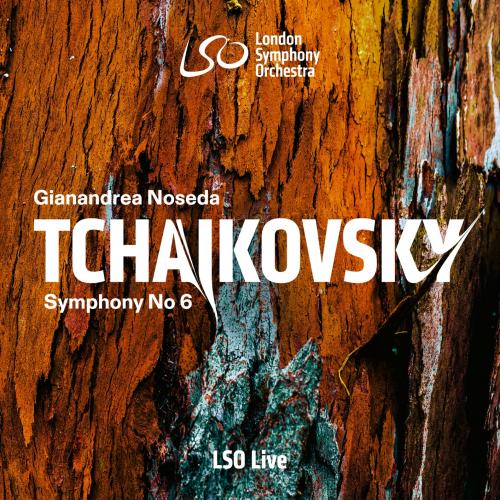
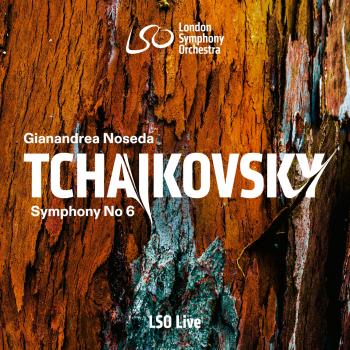
Tchaikovsky: Symphony No. 6 – Mussorgsky: Prelude to Khovanshchina London Symphony Orchestra & Gianandrea Noseda
Album info
Album-Release:
2026
HRA-Release:
06.02.2026
Label: LSO Live
Genre: Classical
Subgenre: Orchestral
Artist: London Symphony Orchestra & Gianandrea Noseda
Composer: Pjotr Iljitsch Tschaikowski (1840-1893), Modest Mussorgsky (1839-1881)
Album including Album cover Booklet (PDF)
- Pyotr Ilyich Tchaikovsky (1840 - 1893): Symphony No. 6 in B Minor, Op. 74 "Pathétique":
- 1 Tchaikovsky: Symphony No. 6 in B Minor, Op. 74 "Pathétique": I. Adagio - Allegro non troppo 16:55
- 2 Tchaikovsky: Symphony No. 6 in B Minor, Op. 74 "Pathétique": II. Allegro con grazia 07:31
- 3 Tchaikovsky: Symphony No. 6 in B Minor, Op. 74 "Pathétique": III. Allegro molto vivace 08:49
- 4 Tchaikovsky: Symphony No. 6 in B Minor, Op. 74 "Pathétique": IV. Finale. Adagio lamentoso - Andante 10:33
- Modest Mussorgsky (1839 - 1881): Khovanshchina:
- 5 Mussorgsky: Khovanshchina: Prelude. Dawn over the Moscow River (Orch. by Rimsky-Korsakov) 05:39
Info for Tchaikovsky: Symphony No. 6 – Mussorgsky: Prelude to Khovanshchina
Tchaikovsky’s final symphony, the ‘Pathétique’, in a dramatic new performance captured live at the Barbican in December 2023. The symphony is followed by Musorgsky’s Prelude to ‘Khovanshchina’, an atmospheric evocation of dawn awakening a slumbering Moscow.
When 19th-century composers wrote minor-key symphonies, they generally followed the ‘darkness-to-light’ model set by Ludwig van Beethoven; even if the finale ended in a dark minor key (like Johannes Brahms’ Fourth Symphony) it would normally be a fast, passionate movement, more defiant than tragic. The quiet, despairing ending of Pyotr Ilyich Tchaikovsky’s Sixth Symphony was unprecedented. This Symphony is the record of a deeply personal experience, expressed with a power that leaves one in no doubt either of Tchaikovsky’s musical mastery or the intensity of his feelings, but it is certainly not music for people who are embarrassed by the expression of strong emotions.
a new symphony but soon put it aside, feeling that something was wrong. He realised that he had been writing out of habit, without any deep commitment, and it was an altogether different sort of symphony that he needed to compose. The sketches were recycled into his Third Piano Concerto, and by the following February the new work was well underway. He completed the orchestration in August and immediately wrote to his brother Anatoly: ‘I’m very proud of the Symphony, and I think it’s the best of my works’ (From a letter to Anatoly Tchaikovsky, dated 12 (Old Style [O.S.]) / 24 (New Style [N.S.]) August 1893). He conducted the first performance on 28 October 1893 in St Petersburg. The response was polite, but apparently not enthusiastic. Tchaikovsky, who was usually extremely sensitive to audiences’ reactions, was not upset on this occasion: ‘It’s not that it displeased, but it produced some bewilderment. As far as I myself am concerned, I take more pride in it than in any other of my works’ (From a letter to Pyotr Jurgenson, Tchaikovsky’s publisher, dated 18 / 30 October 1893), he wrote to his publisher.
When composing it, Tchaikovsky had admitted that it was a symphony ‘with a programme, but with a programme of a kind which remains an enigma to all—let them guess it who can’ (From a letter to Vladimir Davydov, Tchaikovsky’s nephew (son of his sister, Aleksandra), who bore a strong resemblance to the composer. Dated 11 / 23 February 1893). We cannot know exactly what Tchaikovsky had in mind; he never wanted to ‘explain’ his music in any other terms, and when the work was performed it was simply billed as: Sixth Symphony, B minor. On the morning after the first performance, about to send the score for engraving, Tchaikovsky could not make up his mind whether to give it a title at all. He didn’t like the idea of either ‘Tragic Symphony’ or ‘Programme Symphony’, and it was his brother Modest who suggested a title in French: ‘Pathétique’. It sounds odd in English, with its suggestion of weakness or inadequacy. In French or in Russian (‘Pateticheskaya’) the word is more serious, implying the expression of deep feeling and suffering.
The first movement of the ‘Pathétique’, from its opening bassoon crawling up from the depths to its hushed ending, includes a wide variety of musical images. As always in Tchaikovsky, it is the lyrical idea that propels the music; and the economy of texture, rhythmic vitality and clarity of instrumentation ensure that these images strike the listener with immediate force. It is a drama of contrasts, of personal passion struggling against hostile forces. ...
London Symphony Orchestra
Gianandrea Noseda, conductor
Gianandrea Noseda
54, is widely recognized as one of the leading conductors of his generation. He was named the National Symphony Orchestra's seventh music director in January 2016, with a four-year term beginning in the fall of 2017 for the 2017–2018 season.
Noseda has served as Music Director of the Teatro Regio Torino since 2007, ushering in a transformative era for the company matched with international acclaim for its productions, tours, recordings, and film projects. His visionary leadership and ambitious global touring initiatives over the last decade have brought the opera house firmly into the realm of the leading international companies on the global stage, where it has become one of Italy's most important cultural ambassadors. Noseda took the Teatro Regio Torino on two major residencies recently: at the Edinburgh Festival in August 2017 which focused on Verdi with the Messa di Requiem and performances of two fully staged operas and at the Royal Opera House of Muscat, Oman with a production of Aida; the Edinburgh residency was among the longest by a visiting company in the Festival's history.
Noseda also serves as Principal Guest Conductor of the London Symphony Orchestra and the Israel Philharmonic Orchestra, Principal Conductor of the Orquestra de Cadaqués, and Artistic Director of the Stresa Festival in Italy.
In addition to eight weeks with the NSO, highlights of Noseda's 2017–2018 season include appearances with the Israel Philharmonic, New York Philharmonic, and Orchestre de Paris, and a tour of the Far East with the London Symphony Orchestra, in addition to concerts in London. In May 2018, he leads the Met Orchestra at Carnegie Hall for the first time.
Noseda is a frequent guest with the leading opera houses and orchestras in the world, including the Cleveland Orchestra, La Scala, Munich Philharmonic, New York Philharmonic, NHK Symphony, Orchestra dell'Accademia Nazionale di Santa Cecilia, Philadelphia Orchestra, Royal Opera House, Wiener Symphoniker and Zurich Opera. He made his debut with the Berlin Philharmonic in 2015 and at the Salzburg Festival in 2015 leading the Vienna Philharmonic with performances of Il Trovatore.
Noseda also continues to work with institutions where he previously held posts, including the BBC Philharmonic, which he led from 2002–2011; the Pittsburgh Symphony, where the Victor de Sabata Chair was created for him as principal guest conductor; and the Mariinsky Theatre, which appointed him its first-ever foreign principal guest conductor in 1997, a position he held for a decade. He was Principal Guest Conductor of the Rotterdam Philharmonic Orchestra from 1999-2002 and of the Orchestra Sinfonica Nazionale della RAI from 2003 to 2006.
Gianandrea Noseda has a cherished relationship with the Metropolitan Opera
The London Symphony Orchestra
resident at the Barbican Centre, is widely regarded as one of the world’s leading orchestras. The LSO works with an enviable family of artists, including Valery Gergiev, Michael Tilson Thomas and Daniel Harding, and has long-standing relationships with some of the leading musicians in the world. The orchestra enjoys residencies in New York, Paris and Tokyo, in addition to regular tours around the globe. The LSO is set apart from other international orchestras by the depth of its commitment to music education through LSO Discovery, reaching over 65,000 people each year and offering people of all ages opportunities to get involved in music-making. The orchestra is a world-leader in recording music for CD, film and events, and was the official orchestra of the London 2012 Olympic and Paralympic Games Ceremonies.
Booklet for Tchaikovsky: Symphony No. 6 – Mussorgsky: Prelude to Khovanshchina