





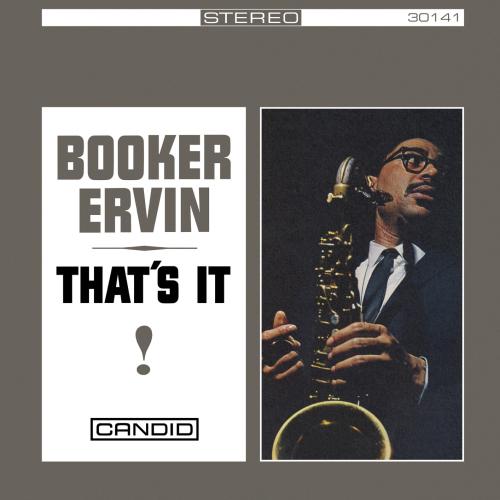
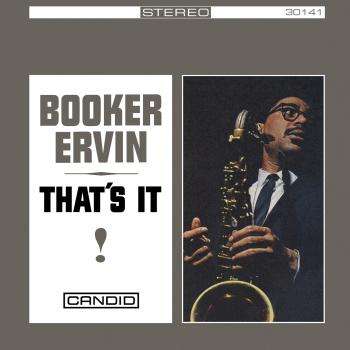
That's It! (Remastered) Booker Ervin
Album info
Album-Release:
2022
HRA-Release:
05.03.2026
Album including Album cover
- 1 Mojo (Remastered) 07:54
- 2 Uranus (Remastered) 04:28
- 3 Poinciana (Remastered) 08:00
- 4 Speak Low (Remastered) 07:08
- 5 Booker's Blues (Remastered) 10:55
- 6 Boo (Remastered) 04:30
Info for That's It! (Remastered)
Mostly associated with Charles Mingus - with whom he recorded 10 albums between 1958 and 1961 - Booker Ervin is one of the great saxophone players of his generation, though arguably lesser known then many of his contemporaries.
That’s It! is only Ervin’s third outing as a band leader. The sessions are no doubt influenced by Ervin’s time with Mingus’ Jazz Workshop, and indeed Mingus is quoted extensively in the album’s liner notes with singular praise for the saxophonist.
Ervin recorded 17 albums under his own name before his untimely death from kidney disease in 1970 at the age of 39.
This album captures Ervin in his prime, with four of his original compositions and his section’s takes on the jazz standards “Poinciana” and “Speak Low.” Of note in the section is the inspired playing by the great jazz pianist Horace Parlan.
Born in Denison TX, Ervin started out at a young age on trombone, but later taught himself to play the tenor saxophone. After studying formally at Berklee College of Music in Boston, Ervin landed in New York City in 1958, where he caught the attention of Charles Mingus.
"Booker Ervin, who always had a very unique sound on the tenor, is heard in prime form on his quartet set with pianist Horace Parlan, bassist George Tucker and drummer Al Harewood. In virtually all cases, the jazz and blues musicians who recorded for Candid in 1960-61 (during its original brief existence) were inspired and played more creatively than they did for other labels. That fact is true for Ervin, even if he never made an indifferent record. In addition to "Poinciana" and "Speak Low," Ervin's quartet (which was a regular if short-lived group) performs four of the leader's originals; best known is "Booker's Blues." (Scott Yanow, AMG)
Booker Ervin, tenor saxophone
Horace Parlan, piano
George Tucker, bass
Al Harewood, drums
Recorded on January 6, 1961 at Nola Penthouse Studios in New York City
Produced by Nat Hentoff
Digitally remastered
Please Note: we do not offer the 192kHz version of this album, because our analysis clearly showed, that the 192kHz does not reach a frequency spectrum, that would justify to offer 192kHz. Hence we offer the 96kHz version.
Booker Ervin
was a hard bop saxophone player and composer. He was born, Booker Telleferro Ervin II, in 1930 in Denison, Texas. He started playing trombone in his youth bur Ervin did not start playing saxophone until he was in the US Air Force. After his discharge he moved to Boston and continue his studies at the Berklee College of Music. Although he did not start playing saxophone until later in life, Ervin quickly excelled as a gifted player and once he completed his time at Berklee he moved to New York to begin his professional career. He began by getting a job with the Horace Parlan Quartet. Parlan was a hard bop pianist who had made a name for himself in New York and would go on to play with Charlie Mingus on many of his important recordings. It was with Parlan's group that Ervin got his first recording experiences when they recorded the albums Up and Down (1961 - Blue Note), which also featured musicians Grant Green on guitar, George Tucker on bass and Al Harewood on drums and Happy Frame of Mind (1963 - Blue Note). Up and Down also opens with an Ervin composition, "The Book's Beat". Happy Frame of Mind also features an Ervin composition, "A Tune for Richard" and the troupe is joined by drummer Billy Higgins. Unfortunately, this latter album sat unreleased until 1976. Before the 50's were over Ervin would also spend some time working with Charlie Mingus and he appears on the recording of the tune "Goodbye Pork Pie Hat".
Although Ervin's solo albums would mark some of the finest playing in jazz, it was his collaborations with Mingus that garner him the most attention. Some of the more notable recordings of Mingus' that Ervin appears on are the albums Mingus Ah Um (1959 - Columbia), which also featured musicians John Handy and Shafi Hadi on saxophones, trombonists Jimmy Knepper and Willie Dennis, drummer Dannie Richmond and pianist Horace Parlan, and the album Mingus Dynasty (1959 - Columbia). Perhaps the most important of Mingus' that he pears on though is the 1963 album Mingus, Mingus, Mingus, Mingus, Mingus (1963 - Impulse!), with musicians Jaki Byard on piano, Eric Dolphy on flute and saxophone, Walter Perkins on drums and Eddie Preston on trumpet.
In 1960 Ervin recorded his first album with Rahsaan Roland Kirk, called Soulful Saxes (1960 - Affinity). That same year he released his first solo album, The Book Cooks (1960 - Bethlehem), where he is joined by Zoot Sims on saxophone, Tommy Turrentine on trumpet, George Tucker on bass, Tommy Flanagan on piano and Dannie Richmond on drums. Ervin penned five of the songs on the album including "The Blue Book", "Git It" and "Little Jane". Before the year was out Ervin had moved on to the Savoy label and he released Cookin' (1960 - Savoy), which also featured several compositions by Ervin such as "Dee Da Do" and "Mr. Wiggles". It was Ervin's album That's It (1961 - Candid) though that would find him leading the group with Horace Parlan rather than being a sideman.
In 1961 Ervin recorded the album Out Front! (1961 - Prestige) with pianist Jaki Byard as leader. This session would pair the two with musicians Walter Perkins on drums and Bob Cranshaw on bass. This same year would fin Ervin playing the Eric Dolphy/Booker Ervin/Mal Waldron Sextet album The Quest (1961 - Prestige) with musicians Ron Carter on bass, Mal Waldron on piano and Charlie Persip on drums. The album consists of all Waldron compositions and puts Ervin in the position of having ot hold his own next to the undisputed master saxophonist Dolphy. Ervin proves himself and these sessions, along with his other works with Mingus attracted many offers from recording labels for future albums.
It was in 1963 that Ervin got a chance to record for the famed Blue Note label as a leader. Unfortunately the sessions would shelved until the 70's when they were released as Back from the Gig (1976 - Blue Note) with musicians Grant Green on guitar, Parlan on piano, Johnny Coles on trumpet along with Woody Shaw.
Beginning with Bad News Blues (1963 - Prestige), Ervin would begin recording a long series of records for the Prestige label in the 60's. He would proceed to record the albums Exultation! (1963 - Prestige), which find him alongside saxophonist Frank Strozier, pianist Parlan, bassist Butch Warren and drummer Perkins, and the album Groovin' High (1964 - Blue Note), which features some lengthier compositions of Ervin's like "Bass-IX" which tops eleven minutes. Jaki Byard contributes his piano skills to this song as well.
It was the next series of albums, known as his book series, though that established Ervin as a strong leader. He released the album Freedom Book (1963 - Prestige), which showcased many Ervin compositions including "A Lunar Tune", "Grant's Stand", "A Day to Mourn" and "Al's In". Next came the album The Song Book (1964 - Prestige), which found Ervin taking on more traditional material such as Duke Ellington's "Come Sunday", the George Gershwin songs "Love is Here to Stay" and the standards "All the Things You Are" and "Just Friends". The last two albums in the series were The Blues Book (1964 - Prestige), which consists of all Ervin compositions like "Eerie Dearie" and "No Booze Blues", and the album The Space Book (1964 - Prestige), which is indeed his most spacey feeling album. Assisted once again by Byard on piano, the group manage to achieve an outerworldly sound, expecially on the two Ervin originals, "Number Two" and "Mojo".
Ervin would continue to record for the Prestige label as well as the Pacific Jazz Label for the remainder of the 60's. He would make waves in the jazz scene with albums like The Trance (1965 - Prestige) and Structurally Sound (1966 - Pacific Jazz). Although Ervin made many major contributions to the world of jazz he has largely been forgotten as a leader and is often only remembered for his stints as sideman for many of the giants of the era. In 1970 cancer claimed his life at the prime of his career. (By Nick Castro)
This album contains no booklet.