


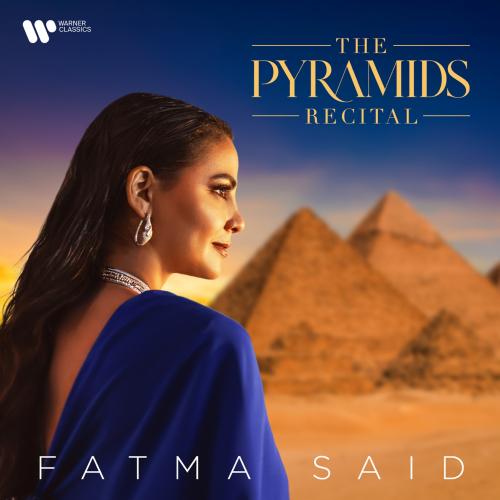
The Pyramids Recital Fatma Said
Album info
Album-Release:
2026
HRA-Release:
09.10.2026
Label: Warner Classics
Genre: Classical
Subgenre: Vocal
Artist: Fatma Said
Composer: Giacomo Puccini (1858-1924), Georg Friedrich Händel (1685-1759), Camille Saint-Saens (1835-1921), Pietro Mascagni (1863-1945), Ruperto Chapi (1851-1909), Robert Stolz (1880-1975), Henri Rabaud (1873-1949), Farid El Atrache (1910-1974), Hans Hammerschmid (1930-2024), Louis Guglielmi (1916-1991), Astor Piazzolla (1921-1992)
Album including Album cover Booklet (PDF)
I`m sorry!
Dear HIGHRESAUDIO Visitor,
due to territorial constraints and also different releases dates in each country you currently can`t purchase this album. We are updating our release dates twice a week. So, please feel free to check from time-to-time, if the album is available for your country.
We suggest, that you bookmark the album and use our Short List function.
Thank you for your understanding and patience.
Yours sincerely, HIGHRESAUDIO
- Giacomo Puccini (1858–1924): Gianni Schicchi, Act 1:
- 1 Puccini: Gianni Schicchi, Act 1: "O mio babbino caro" (Lauretta) 02:20
- Wolfgang Amadeus Mozart (1756–1791): Le nozze di Figaro, K. 492, Act 1:
- 2 Mozart: Le nozze di Figaro, K. 492, Act 1: "Non so più cosa son, cosa faccio" (Cherubino) 03:09
- George Frideric Handel (1685–1759): Rinaldo, HWV 7, Act 2:
- 3 Handel: Rinaldo, HWV 7, Act 2: Aria. "Lascia ch'io pianga" (Almirena) 04:45
- Camille Saint-Saëns (1835–1921): Henry VIII, Act 2:
- 4 Saint-Saëns: Henry VIII, Act 2: Danse de la gipsy 02:04
- Pietro Mascagni (1863–1945): Ave Maria (After Cavalleria rusticana's Intermezzo):
- 5 Mascagni: Ave Maria (After Cavalleria rusticana's Intermezzo) 03:20
- Ruperto Chapí (1851–1909): Las hijas del Zebedeo, Act 2:
- 6 Chapí: Las hijas del Zebedeo, Act 2: Las carceleras. "Al pensar en el dueño de mis amores" (Luisa) 05:01
- Robert Stolz (1880–1975): Venus in Seide, Act 1:
- 7 Stolz: Venus in Seide, Act 1: "Spiel auf deiner Geige" (Jadja) 03:54
- Henri Rabaud (1873–1949): Mârouf, savetier du Caire, Act 3:
- 8 Rabaud: Mârouf, savetier du Caire, Act 3: Danses 02:59
- Farid El Atrach (1910–1974): Ya zahratan fi khayali:
- 9 Atrache: Ya zahratan fi khayali 03:21
- Hans Hammerschmid (1930–2024): Für mich soll’s rote Rosen regnen:
- 10 Hammerschmid: Für mich soll’s rote Rosen regnen 03:02
- Louis “Louiguy” Guglielmi (1916–1991): La vie en rose:
- 11 Guglielmi: La vie en rose 04:07
- Astor Piazzolla (1921–1992): María de Buenos Aires, Scene 3:
- 12 Piazzolla: María de Buenos Aires, Scene 3: "Yo soy María" (María) [Orch. Soudoplatoff] 03:12
- Jeff Barnel (b.1947) & Bernard Liamis (b.1945): Comment l’oublier / Helwa ya baladi:
- 13 Barnel, Liamis: Comment l’oublier / Helwa ya baladi 04:30
- Mohamed Abdelwahab (1902–1991):La mosh ana-l-abki:
- 14 Wahab: La mosh ana-l-abki 04:47
- Najib Hankash (1904–1977): Aatini al naya wa ghanni:
- 15 Hankash: Aatini al naya wa ghanni 04:25
- Richard Strauss (1864–1949): 4 Lieder, Op. 27:
- 16 Strauss: 4 Lieder, Op. 27: No. 4, Morgen! 03:38
Info for The Pyramids Recital
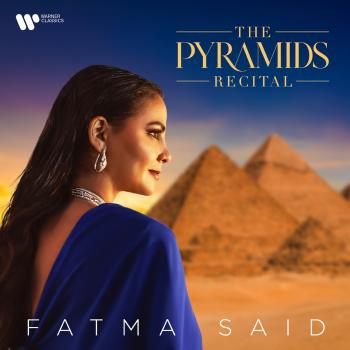
Songs from across continents and time come together before the majestic backdrop of the pyramids of Giza in this one-of-a-kind musical project, starring Fatma Said. Accompanied by the musicians of Les Frivolités Parisiennes and conductor Sammy El Ghadab, the Egyptian soprano dazzles with a multifaceted and multilingual program that ranges from opera arias and German lieder to French chansons and famous Arabic songs. The immersive audio and visual production of Fatma Said’s Pyramids Recital marks a celebration of timeless, cross-cultural music and ancient wonder.
Captured during a golden evening sunset in autumn 2025, the recording takes place in Egypt’s desert, steeped with millennia of history: behind the performers stands the Great Pyramid of Giza—built more than 4,000 years ago, and the oldest of the Seven Wonders of the Ancient World—along with its companions on this UNESCO World Heritage Site, the pyramids of the pharaohs Khafre and Menkaure. It is within this idyllic setting that Fatma Said sets out on a musical journey that is, at once, intimate and infinitely vast.
"The pyramids are behind me, we’re bathed in the glow of the setting sun, I’m here, singing: an experience like no other I’ve ever had. Performing in front of the pyramids, there were really distinctive acoustics, something I had never experienced before in my life. The sound was everywhere, in the sand, in the wind… I was encircled by the wind, and my voice became part of the wind, inspired by the whole setting, by this place that has seen so much, experienced so much."
Her carefully chosen setlist showcases lyrics and libretti in five languages: Arabic, French, German, Italian and Spanish. It opens with the familiar notes of Puccini’s “O mio babbino caro”, and alongside other opera arias by notable composers (including Mozart, Handel and Saint-Saëns) are Mascagni’s “Ave Maria”, and Richard Strauss’s “Morgen!”. These and other iconic classical pieces are woven into a vivid tapestry of masterpieces from different cultural influences and genres, including “La Vie en rose”, the signature song of the French singer Édith Piaf; the fiery “Yo Soy María” from Ástor Piazzolla’s tango opera María de Buenos Aires; and a selection of Arabic songs that are especially dear to Fatma’s heart. They include “Helwa ya baladi”, a passionate homage to her homeland of Egypt first sung by Dalida; “Aatini Al Naya Wa Ghanni”, made famous by the Lebanese singer Fairouz and featuring the poetry of Gibran Khalil Gibran; and “La mosh ana-l-abki”, written by one of Egypt’s most influential and celebrated musical figures, Mohammed Abdel Wahab.
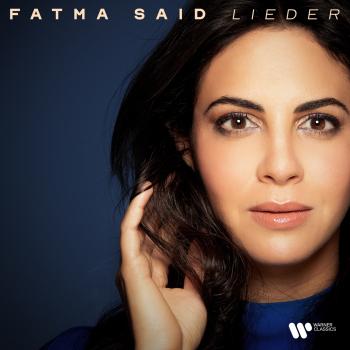
While soprano Fatma Said’s previous Warner Classics releases crossed cultures and musical genres, this album focuses entirely on German-language songs of the Romantic era: Lieder by Schubert, Mendelssohn, Schumann and Brahms. At the age of 18 Fatma left her native Cairo to study at the Hanns Eisler Conservatory in Berlin and
“Ever since my time at the German school in Cairo, the joy of singing this genre has been central to my musical life … I am very passionate about lieder … This wonderful combination of great German poetry and genius composers like Schubert, Schumann, Mendelssohn, and Brahms.”
In the conventional course of things, a lieder recital involves one singer and one pianist, but Fatma Said, saying “I’ve always wanted to make music with friends”, has called on the talents of pianist Malcolm Martineau and Joseph Middleton, alongside harpist Anneleen Lenaerts, clarinettist Sabine Meyer (in Schubert’s ‘Der Hirt auf dem Felsen’), Quatuor Arod (accompanying Brahms’ Ophelia-Lieder in an arrangement by Aribert Reimann), male-voice ensemble Walhalla zum Seidlwirt with their own pianist member Yonatan Cohen, and another singer on the ascent – baritone Huw Montague Rendall. The programme features some of the world’s best-loved lieder, such as Schubert’s ‘Ständchen’, Schumann’s ‘Widmung’ and Brahms’ ‘Wie Melodien zieht es mir’, but it also explores less familiar repertoire. Throughout the album, Fatma Said places a crucial emphasis on the poetic texts:
“My priority was to convey the characterisation of the words most of all … Differentiating between diverse kinds of expressive worlds is for me what lieder-singing is all about.”
Fatma Said, soprano
Les Frivolites Parisiennes
Sammy El Ghadab, conductor
Fatma Said
At the age of 14 Fatma Said embarked on a musical journey that would take her from her home in Cairo to the Academy of Milan’s Teatro alla Scala, the BBC Radio 3 New Generation Artists and ultimately to the world’s most prestigious concert and opera stages. Fatma is an exclusive Warner Recording Artist and has won numerous awards including the Gramophone Classical Music Award, the BBC Music Magazine’s Vocal Award as well as Germany’s Opus Klassik.
Fatma took her first singing lessons in Cairo with soprano Neveen Allouba and later studied Opera Singing at Hochschule für Musik Hanns Eisler with Professor Renate Faltin. Fatma subsequently was awarded a scholarship to study at the Accademia del Teatro alla Scala in Milan, becoming the first Egyptian soprano to perform on this iconic stage. In Milan she sang - among numerous other roles - Pamina in a new Peter Stein production of Mozart’s Die Zauberflöte, after which Frankfurter Allgemeine Zeitung heralded, “The flawless, radiant Fatma Said as Pamina is a discovery.”
Fatma is thrilled to embark on an exciting 2024/25 season. Highlights include her debut with the Berliner Philharmoniker, Luzerner Sinfonieorchester, and WDR Sinfonieorchester and she will ring in the New Year 2025 with a gala performance for the ZDF also marking her debut with Staatskapelle Dresden. Continuing her successful partnership with Malcom Martineau and Sabine Meyer, Fatma will perform as part of a trio at Wigmore Hall and Schloss Elmau, and present solo recitals at the Schubertiade festival in Austria and Casino Basel. A passionate Lied singer, Fatma eagerly anticipates the release of a German song album “Lieder” with Warner Classics in February 2025.
Recent highlights from previous seasons include acting as Artist in Residence at the Wiener Konzerthaus, touring her second album Kaleidoscope released on Warner Classics in 2022 and a dynamic residency with the Konzerthaus Berlin where she presented a range of colourful programs. She has also appeared on prestigious stages worldwide, including a gala concert at the Grand Egyptian Museum in Cairo and two appearances at the annual Concert de Paris in 2020 and 2024.
Throughout the past years she has also appeared on the stages of Teatro San Carlo in Naples, Staatsoper Hamburg, Royal Opera House in Muscat, Wexford Opera in Ireland, Gewandhaus in Leipzig, Philharmonie Cologne, Konzerthaus Berlin, Royal Albert Hall in London, Mozarteum in Salzburg, Vienna Konzerthaus, Tonhalle Düsseldorf, Pembroke Music Festival, Schubertiade Festival of Valdegovia, Lockenhaus Festival, Schumann Festival in Bonn, Mozart-Woche in Salzburg, Beethoven Festival in Bonn, and the Music Festival of Bad Kissingen amongst others.
Fatma’s operatic roles on stage include Pamina (Die Zauberflöte), Nannetta (Falstaff), Clorinda (La Cenerentola), and the role of L’Amour (Orphée et Eurydice) at the Teatro alla Scala among others. She sang Genovieffa (Suor Angelica) with the Boston Symphony Orchestra and Andris Nelsons in a concert performance and the main role Tharsis in the new production of Mozart’s T.H.A.M.O.S. during the Mozart-Woche Festival 2019 in Salzburg staged by Fura Dels Baus.
Fatma Said is a strong advocate for causes that are close to her heart: In September 2021, Fatma performed at Global Citizen Live – a worldwide 24-hour livestreamed charity event which sees artists from around the world campaign to end the hunger crisis, protect the planet and plan its recovery from the COVID-19 pandemic. The artists lineup included musicians such as Elton John and Ed Sheeran. She represented Egypt on Human Right’s Day in 2014, 2017 and 2018 at the United Nations in Geneva as well as at the Luxor Temple and sang for children's right to education and dignity through music. In 2016, she received an honorary award from Egypt’s National Council for Women. In the same year she became the first Egyptian opera singer ever to be awarded the state’s Creativity Award, one of Egypt’s highest accolades, for her outstanding artistic achievement on an international level.
In 2023 Fatma received the Rafik Hariri Award from the Atlantic Council in Washington for her artistic excellence and in 2024 she was awarded the European Cultural Price in Luxembourg.
Fatma continues working with Professor Renate Faltin and has had distinguished professors and coaches, such as Julia Varady, Claar Ter Horst, Anita Keller, Wolfram Rieger and Tom Krause, who have strongly influenced her musical development and helped her hone her musical interpretation.
Fatma won several major singing competitions including the 8th Veronica Dunne International Singing Competition (Dublin, 2016), the 7th Leyla Gencer International Opera Competition (Istanbul, 2012), 2nd prize at the 16th International Robert Schumann Lied Competition (Zwickau, 2012) and the Grand Prix at the 1st Giulio Perotti International Opera Competition (Germany, 2011).
Booklet for The Pyramids Recital