







The Danish composer Peter Heise is best known for his numerous songs and, to some, for his opera Drot og marsk (King and Marshal). Even his contemporaries were largely unaware that he had written string quartets. Heise left behind a total of six such compositions, each in four movements. The Nordic String Quartet has now recorded them in their entirety and released them on Peter Heise: Complete String Quartets – three of them recorded for the very first time.
It seems a curious fact that the best-known and most popular composer in 19th-century Denmark wrote such works and yet nobody thought of them. However, during his lifetime, string quartets were a private pleasure, and public performances of such works were not heard until 1854. The sixth and final string quartet, dated 1857, is the only one to have been written after this premiere; Heise had long since composed all the other string quartets, most of them in 1854 at the age of 24. It is therefore not surprising that after Heise’s death in 1879 these works fell into oblivion – they simply had no large public audience.
Today, a stage is no longer needed to bring forgotten works back into the public eye. For Heise’s string quartets, three CDs or 24 studio master files are enough to breathe new life into their sounds. And these are astonishingly diverse. Admittedly, Heise adheres to the conventions of the genre in the mid-19th century, and much of it seems conventional. The runs, the repetitions, the dynamics – it is familiar. And yet, it is not.
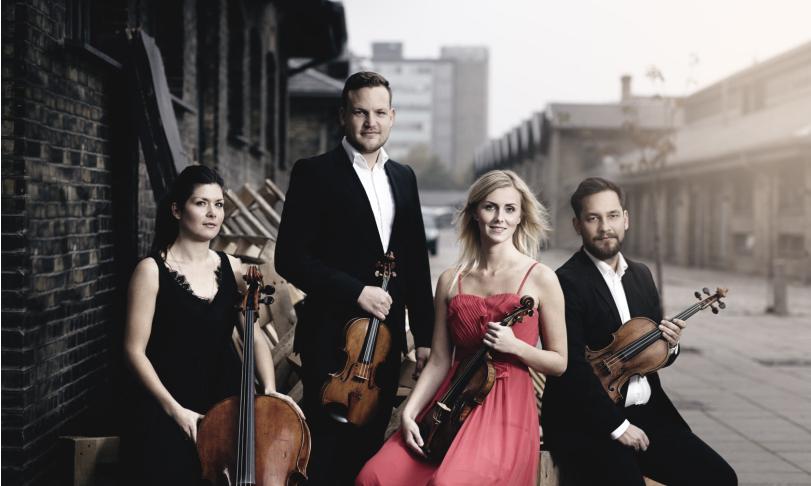
Heise’s compositions are emotional in the best sense of the word. Their structure and tonality give the musicians scope for expression and depth, which violinist Hei∂run Petersen, violinist Mads Haugsted Hansen, Daniel Eklund on the viola and cellist Lea Emilie Brøndal make excellent use of. The quartet from Denmark, Sweden and the Faroe Islands unfurls its tapestry of sound almost like an invitation to settle down and enjoy.
Particular mention must be made of Quartet No. 2 as a whole. The evocative mood of the second movement, in particular, and its contrast with the lively third movement, are outstanding testaments to the quality of both the Nordic String Quartet and the Danish composer.
The enjoyment is further enhanced by the quality of the recording. The chamber musicians are positioned in a spacious room; they seem integrated yet are clearly distinguishable. The atmosphere is, as it were, intimate, so much so that the wood of the viola, as well as that of the other string instruments, resonates fantastically through the speakers.
After more than two and a half hours of musical entertainment, we can be glad that what was written on the folder containing the 1st String Quartet did not happen to the compositions: “Heise’s handwritten music from days gone by, not to be printed, perhaps better to be burnt”.
Heise’s “early works”, as the folder containing the remaining five string quartets was titled, are magnificent pieces and mature, skilful compositions. It is a pleasure to be able to hear them in their entirety for the first time.
Nordic String Quartet