


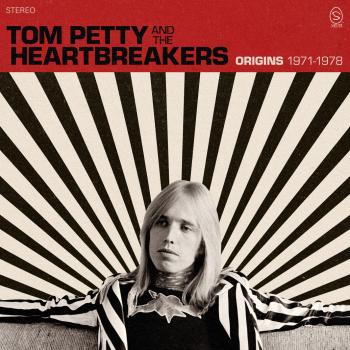




Tom Petty And The Heartbreakers (Remastered) Tom Petty And The Heartbreakers
Album Info
Album Veröffentlichung:
1976
HRA-Veröffentlichung:
28.06.2024
Das Album enthält Albumcover
Entschuldigen Sie bitte!
Sehr geehrter HIGHRESAUDIO Besucher,
leider kann das Album zurzeit aufgrund von Länder- und Lizenzbeschränkungen nicht gekauft werden oder uns liegt der offizielle Veröffentlichungstermin für Ihr Land noch nicht vor. Wir aktualisieren unsere Veröffentlichungstermine ein- bis zweimal die Woche. Bitte schauen Sie ab und zu mal wieder rein.
Wir empfehlen Ihnen das Album auf Ihre Merkliste zu setzen.
Wir bedanken uns für Ihr Verständnis und Ihre Geduld.
Ihr, HIGHRESAUDIO
- 1 Rockin' Around (With You) 02:26
- 2 Breakdown 02:42
- 3 Hometown Blues 02:14
- 4 The Wild One, Forever 03:01
- 5 Anything That's Rock 'N' Roll 02:23
- 6 Strangered In The Night 03:32
- 7 Fooled Again (I Don't Like It) 03:54
- 8 Mystery Man 03:04
- 9 Luna 03:59
- 10 American Girl 03:33
Info zu Tom Petty And The Heartbreakers (Remastered)
Tom Petty & The Heartbreakers is the self-titled debut album by the American rock band Tom Petty and The Heartbreakers. Released by Rhino, this iconic album showcases the raw talent and infectious energy that would define their sound for decades to come.
With its release in 1976, Tom Petty & The Heartbreakers introduced the world to a unique blend of rock and roll, country, and blues influences. From the opening track "Rockin' Around (With You)" to the closing notes of "American Girl," each song on this album captures the spirit of American rock music at its finest.
The album features standout tracks like "Breakdown" and "Fooled Again (I Don't Like It)," which became instant classics and remain fan favorites to this day. These songs showcase Tom Petty's distinctive vocals and heartfelt lyrics, backed by The Heartbreakers' tight musicianship.
Tom Petty & The Heartbreakers is a testament to the band's ability to create timeless music that resonates with listeners across generations. Whether you're a longtime fan or new to their music, this album is a must-have for any collection.
Experience the magic of Tom Petty & The Heartbreakers with this deluxe edition from Rhino. This remastered version includes bonus tracks and rare recordings, giving fans an even deeper look into the early days of one of America's most beloved rock bands.
Add Tom Petty & The Heartbreakers to your music library today and discover why they continue to be one of the most influential bands in rock history.
"At the time Tom Petty & the Heartbreakers' debut was released in 1976, they were fresh enough to almost be considered punk. They weren't as reckless or visionary as the Ramones, but they shared a similar love for pure '60s rock and, for the Heartbreakers, that meant embracing the Byrds as much as the Stones. And that's pretty much what this album is -- tuneful jangle balanced by a tough garage swagger. At times, the attitude and the sound override the songwriting, but that's alright, since the slight songs ("Anything That's Rock 'N' Roll," to pick a random example) are still infused with spirit and an appealing surface. Petty & the Heartbreakers feel underground on this album, at least to the extent that power pop was underground in 1976; with Dwight Twilley providing backing vocals for "Strangered in the Night," the similarities between the two bands (adherence to pop hooks and melodies, love of guitars) become apparent. Petty wound up eclipsing Twilley because he rocked harder, something that's evident throughout this record. Take the closer "American Girl" -- it's a Byrds song by any other name, but he pushed the Heartbreakers to treat it as a rock & roll song, not as something delicate. There are times where the album starts to drift, especially on the second side, but the highlights -- "Rockin' Around (With You)," "Hometown Blues," "The Wild One, Forever," the AOR staples "Breakdown" and "American Girl" -- still illustrate how refreshing Petty & the Heartbreakers sounded in 1976." (Stephen Thomas Erlewine, AMG)
Tom Petty, vocals, electric guitar, acoustic guitar, Hammond organ
Mike Campbell, electric guitar, acoustic guitar
Benmont Tench, piano, Hammond organ, synthesizer
Ron Blair, bass guitar (tracks 1–2, 4–5, 7–10), cello (track 4)
Stan Lynch, drums (tracks 1–2, 4–5, 7–10), synthesizer (track 9)
Additional musicians:
Jeff Jourard, electric guitar (tracks 2, 6–8)
Donald "Duck" Dunn, bass (track 3)
Emory Gordy, bass (track 6)
Randall Marsh, drums (track 3)
Jim Gordon, drums (track 6)
Noah Shark, maracas, tambourine, sleigh bells
Charlie Souza, saxophone (track 3)
Phil Seymour, backing vocals (tracks 2, 10)
Dwight Twilley, backing vocals (track 6)
Digitally remastered


Tom Petty And The Heartbreakers
Upon the release of their first album in the late ’70s, Tom Petty & the Heartbreakers were shoehorned into the punk/new wave movement by some observers who picked up on the tough, vibrant energy of the group’s blend of Byrds riffs and Stonesy swagger. In a way, the categorization made sense. Compared to the heavy metal and art rock that dominated mid-’70s guitar rock, the Heartbreakers’ bracing return to roots was nearly as unexpected as the crashing chords of the Clash. As time progressed, it became clear that the band didn’t break from tradition like their punk contemporaries. Instead, they celebrated it, culling the best parts of the British Invasion, American garage rock, and Dylanesque singer/songwriters to create a distinctively American hybrid, recalling the past without being indebted to it.
The Heartbreakers were a tight, muscular, and versatile backing band that provided the proper support for Petty’s songs, which cataloged a series of middle-class losers and dreamers. While his slurred, nasal voice may have recalled Dylan and Roger McGuinn, Petty’s songwriting was lean and direct, recalling the simple, unadorned style of Neil Young. Throughout his career, Petty & the Heartbreakers never departed from their signature rootsy sound, but they were able to expand it, bringing in psychedelic Southern rock and new wave influences; they were also one of the few of the traditionalist rock & rollers who embraced music videos, filming some of the most inventive and popular videos in MTV history. His willingness to experiment with the boundaries of classic rock & roll helped Petty sustain his popularity well into the 21st century.
Born and raised in northern Florida, Petty began playing music while he was still in high school. At the age of 17, he dropped out of school to join Mudcrutch, which also featured guitarist Mike Campbell and keyboardist Benmont Tench. By 1970, Mudcrutch had moved to Los Angeles with hopes of finding a record contract. The fledgling Shelter Records, founded by Leon Russell and Denny Cordell, offered the group a contract. However, Mudcrutch splintered apart shortly after relocating to L.A. Cordell was willing to record Petty as a solo act, but the singer’s reception to the idea was tentative. Over the next few years, Petty drifted through bands, eventually hooking back up with Campbell and Tench in 1975. At the time, the duo were working with bassist Ron Blair and drummer Stan Lynch; soon, Petty became involved with the band, which was then named the Heartbreakers. Petty was still under contract to Shelter, and the group assumed his deal, releasing Tom Petty & the Heartbreakers in 1976.
Initially, the band’s debut was ignored in the United States, but when the group supported it in England with a tour opening for Nils Lofgren, the record began to take off. Within a few months, the band was headlining its own British tours and the album was in the U.K. Top 30. Prompted by the record’s British success, Shelter pushed the album and the single “Breakdown” in the U.S., this time with success; “Breakdown” became a Top 40 hit and “American Girl” became an album-oriented radio staple. You’re Gonna Get It, the Heartbreakers’ second album, was released in 1978 and it became the group’s first American Top 40 record. Petty & the Heartbreakers were poised to break into the big time when they ran into severe record company problems. Shelter’s parent company, ABC, was bought by MCA, and Petty attempted to renegotiate his contract with the label. MCA was unwilling to meet most of his demands, and halfway through 1979, he filed for bankruptcy. Soon afterward, he settled into an agreement with MCA, signing with their subsidiary Backstreet Records. Released late in 1979, Damn the Torpedoes was his first release on Backstreet.
Damn the Torpedoes was Petty’s breakthrough release, earning uniformly excellent reviews, generating the Top Ten hit “Don’t Do Me Like That” and the number 15 “Refugee,” and spending seven weeks at number two on the U.S. charts; it would eventually sell over two million copies. Though he was at a peak of popularity, Petty ran into record company trouble again when he and the Heartbreakers prepared to release Hard Promises, the 1981 follow-up to Damn the Torpedoes. MCA wanted to release the record at the list price of $9.98, which was a high price at the time. Petty refused to comply to their wishes, threatening to withhold the album from the label and organizing a fan protest that forced the company to release the record at $8.98. Hard Promises became a Top Ten hit, going platinum and spawning the hit single “The Waiting.” Later that year, Petty produced Del Shannon’s comeback album Drop Down and Get Me and wrote “Stop Draggin’ My Heart Around” as a duet for himself and Stevie Nicks. Featured on her album Bella Donna, which was recorded with the Heartbreakers’ support, “Stop Draggin’ My Heart Around” became a number three hit. Petty & the Heartbreakers returned late in 1982 with Long After Dark, which became their third Top Ten album in a row. Following its release, bassist Ron Blair left the band and was replaced by Howie Epstein, who previously played with John Hiatt.
Petty & the Heartbreakers spent nearly three years making Southern Accents, the follow-up to Long After Dark. Hiring Eurythmics’ Dave Stewart as a producer, the band attempted to branch out musically, reaching into new territories like soul, psychedelia, and new wave. However, the recording wasn’t easy — at its worst, Petty punched a studio wall and broke his left hand, reportedly in frustration over the mixing. Southern Accents was finally released in the spring of 1985, preceded by the neo-psychedelic single “Don’t Come Around Here No More,” which featured a popular, pseudo-Alice in Wonderland video. Southern Accents was another hit record, peaking at number seven and going platinum. Following its release, Petty & the Heartbreakers spent 1986 on tour as Bob Dylan’s backing band. Dylan contributed to the lead single “Jammin’ Me,” from the Heartbreakers’ next album, Let Me Up (I’ve Had Enough), which was released to mixed reviews in the spring of 1987. Just after the record’s release, Petty’s house and most of his belongings were destroyed by fire; he, his wife, and two daughters survived unscathed.
In 1988, Petty became a member of the supergroup the Traveling Wilburys, which also featured Dylan, George Harrison, Roy Orbison, and Jeff Lynne. The Wilburys released their first album at the end of 1988 and its sound became the blueprint for Petty’s first solo effort, 1989’s Full Moon Fever. Produced by Lynne and featuring the support of most of the Heartbreakers, Full Moon Fever became Petty’s commercial pinnacle, reaching number three on the U.S. charts, going triple platinum, and generating the hit singles “I Won’t Back Down,” “Runnin’ Down a Dream,” and “Free Fallin’,” which reached number seven. In 1990, he contributed to the Traveling Wilburys’ second album, Vol. 3. Petty officially reunited with the Heartbreakers on Into the Great Wide Open, which was also produced by Jeff Lynne. Released in the spring of 1991, Into the Great Wide Open sustained the momentum of Full Moon Fever, earning strong reviews and going platinum.
Following the release of 1993’s Greatest Hits, which featured two new tracks produced by Rick Rubin, including the Top 20 hit “Mary Jane’s Last Dance,” Petty left MCA for Warner Bros.; upon signing, it was revealed that he negotiated a $20 million deal in 1989. Drummer Stan Lynch left the Heartbreakers in 1994, as Petty was recording his second solo album with producer Rubin and many members of the Heartbreakers. Like Full Moon Fever before it, 1994’s Wildflowers was greeted by enthusiastic reviews and sales, tying his previous solo album for his biggest-selling studio album. In addition to going triple platinum and peaking at number eight, the album spawned the hit singles “You Don’t Know How It Feels,” “You Wreck Me,” and “It’s Good to Be King.” Petty & the Heartbreakers reunited in 1996 to record the soundtrack for the Edward Burns film She’s the One. The resulting soundtrack album was a moderate hit, peaking at number 15 on the U.S. charts and going gold. Echo followed three years later, becoming the first Heartbreakers record to make the Top Ten in almost 15 years.
The Last DJ, a scathing attack on the corporate greed inherent in the music business, was released in 2002, followed in 2006 by a solo album, Highway Companion; both albums reached the Top Ten, and Highway Companion went gold in the U.S. After this, Petty reunited his original band Mudcrutch for a 2008 album and tour. Mojo, credited to Tom Petty & the Heartbreakers, appeared from Reprise in 2010. The band toured fairly regularly over the next four years, then returned in the summer of 2014 with Hypnotic Eye, the first number one album in their career. Two years later, Petty reconvened Mudcrutch for their second album, appropriately entitled 2. On October 2, 2017, Petty was found at his home in cardiac arrest, and he died at a hospital in Santa Monica later that day. Nearly a year later, his family and band released the box set An American Treasure as a tribute to the departed rocker. A double-disc hits collection, The Best of Everything, followed in March 2019.
Dieses Album enthält kein Booklet