

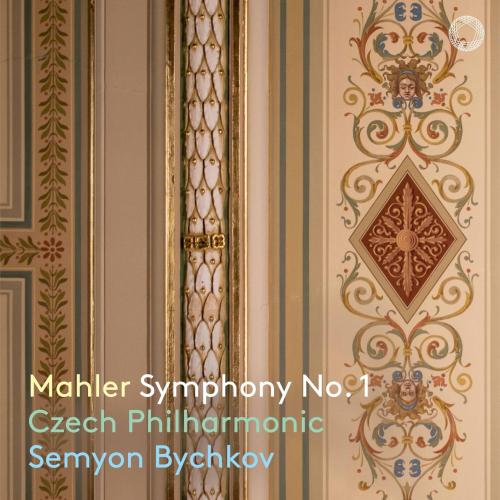
Mahler: Symphony No. 1 Czech Philharmonic & Semyon Bychkov
Album Info
Album Veröffentlichung:
2023
HRA-Veröffentlichung:
08.09.2023
Label: PentaTone
Genre: Classical
Subgenre: Orchestral
Interpret: Czech Philharmonic & Semyon Bychkov
Komponist: Gustav Mahler (1860-1911)
Das Album enthält Albumcover Booklet (PDF)
- Gustav Mahler (1860 - 1911): Symphony No. 1 in D Major "Titan":
- 1 Mahler: Symphony No. 1 in D Major "Titan": I. Langsam, schleppend - Immer sehr gemächlich 16:39
- 2 Mahler: Symphony No. 1 in D Major "Titan": II. Kräftig bewegt, doch nicht zu schnell 07:29
- 3 Mahler: Symphony No. 1 in D Major "Titan": III. Feierlich Und Gemessen, Ohne Zu Schleppen 10:34
- 4 Mahler: Symphony No. 1 in D Major "Titan": IV. Stürmisch Bewegt 20:31
Info zu Mahler: Symphony No. 1
Die Tschechische Philharmonie und ihr Musikdirektor Semyon Bychkov setzen ihren gefeierten Mahler-Zyklus mit der Ersten Symphonie des Komponisten fort, einem der eindrucksvollsten und farbenreichsten symphonischen Debütwerke in der Geschichte der Gattung. Mahler sagte einmal: "Eine Sinfonie sollte wie die Welt sein, sie sollte alles umfassen". In seiner Ersten Sinfonie erschafft er eine solche Welt, gefüllt mit Tiergeräuschen, Jagdhörnern, ländlichen Tänzen, Klezmer-Bands und Anspielungen auf seine eigenen Lieder und Volksliedmelodien wie Frere Jacques. All diese Elemente funktionieren innerhalb eines höchst subjektiven, eindringlichen symphonischen Dramas, das eine Blaupause für die meisten seiner späteren Symphonien darstellt. Semyon Bychkov und die Tschechische Philharmonie nähern sich dem Erstling des Komponisten mit ihrem geschätzten Blick für Details und Tempo, gepaart mit ihrem unverwechselbaren böhmischen Klang.
Die Tschechische Philharmonie ist eines der größten Orchester der Welt, das für seine reiche Tradition mit den tschechischen Meistern und dem europäischen Repertoire bekannt ist. Semyon Bychkov, der international für seine Interpretationen des Kernrepertoires bekannt ist, begann seine Amtszeit mit dem Orchester zu Beginn der Saison 2018/19. Die Einspielung von Mahlers Erster Sinfonie folgt auf Mahlers Vierte und Fünfte Sinfonie (beide 2022) und die Zweite Sinfonie (2023), die Teil des gesamten Mahler-Zyklus sind, der von Pentatone veröffentlicht wird.
Tschechische Philharmonie
Semyon Bychkov, Dirigent


Semyon Bychkov
Chief Conductor and Music Director of the Czech Philharmonic, Semyon Bychkov marked the Orchestra’s 130th anniversary in 2026 with extensive tours of Asia and Europe and, PENTATONE’s release of Mahler’s Nine Symphonies. In 2026/27, he returns to the repertoire of his formative years, and alongside Czech masters will conduct works by Shostakovich, Rachmaninov and Mussorgsky. “What amazes me is how strongly Shostakovich’s existential music resonates in a world which seems, outwardly, very different from the one in which he was fighting for his life both as a human being and a composer. But maybe we’re all faced with a struggle to be true to ourselves against odds of various kinds, even insidious ideologies which hide their true nature.”
Born in Leningrad in 1952, Bychkov emigrated to the United States in 1975 and, since the mid-1980’s has lived in Europe. He enjoyed success as Music Director of the Grand Rapids Symphony Orchestra and the Buffalo Philharmonic and, following a series of high-profile cancellations leading to engagements with the New York and Berlin Philharmonic orchestras and the Concertgebouw, returned to St Petersburg in 1989 as the Philharmonic’s Principal Guest Conductor. He was named Music Director of the Orchestre de Paris (1989); Chief Conductor of the WDR Symphony Orchestra Cologne (1997); and Chief Conductor of the Dresden Semperoper (1998). From August 2026, Bychkov will be Music Director Designate of the Paris Opera, assuming the title of Music Director in 2028.
Bychkov conducts in all the major opera houses including La Scala, Milan, London’s Royal Opera House and New York’s Metropolitan Opera. In Europe he is frequent guest of the Concertgebouw, Munich, Berlin and Vienna Philharmonics, the Leipzig Gewandhaus, the Orchestre National de France and the Accademia Nazionale di Santa Cecilia; while in the US, he conducts the New York Philharmonic, Chicago Symphony, Los Angeles Symphony, San Francisco Symphony and, Philadelphia and Cleveland Orchestras. The warmth of Bychkov’s relationships is reflected in honorary titles at the Royal Academy of Music and the BBC Symphony Orchestra, who he regularly conducts at the BBC Proms.
Semyon Bychkov was named Conductor of the Year by the International Opera Awards (2015) and, by Musical America (2022).
Born in Leningrad (now St Petersburg), Semyon Bychkov was 22 when he left Russia to make a new start in the USA. With extensive experience in Europe and throughout the world, he has been a truly international artist for more than a quarter of a century, yet he firmly believes his Russian upbringing is of crucial importance to the man and artist he has become.
‘Those years were vital,’ he says. ‘They were what allowed me, later on, to be enriched by other cultures. I believe that everything we live through can be, and should be, considered beneficial. Whether it is joyful or painful is beside the point.
Even the negative aspects of my time in the Soviet Union were of value. They taught me to distinguish between what is positive and what is negative. And the negatives make you stronger, because if you have the willpower to resist them you are going to be OK.
‘This, I guess, is what people call ‘roots’. I think the deeper the roots and the wider they spread the better. And, of course, you do not grow up alone. I had the extraordinary privilege to encounter people who played an enormous role in my upbringing, musical and personal.’
One of the most significant of these people was the legendary conducting teacher Ilya Musin, who taught in Leningrad/St Petersburg for 65 years. ‘Musin was everything,’ says Bychkov. ‘At 95 years of age he still had something to learn, progress to make.
“He was able to develop a philosophy of conducting that combined the three fundamental questions that exist in everything one tries to do. The first is ‘what?’, the second is ‘why?’, the third is ‘how?’.
Conducting is the youngest musical profession anyway and still not really understood. But a great part of Musin’s genius was that once he had figured out the answers to those three questions for himself, he still took into account that every person has their own physique and personality. One person will be tall with short arms; another will be short with long arms; some people are immediately able to ape someone else’s movements, others are so inhibited that they can never do it. He was able to appreciate the capabilities and the mental constitution of a very individual student. And then he would help this person to achieve what he or she wanted, as opposed to producing another model from the assembly line.
Musin was a very kind man, full of very quiet humour. But occasionally he would get so hot, so mad – and it would last exactly five seconds. He would calm down just as quickly.’
Booklet für Mahler: Symphony No. 1