
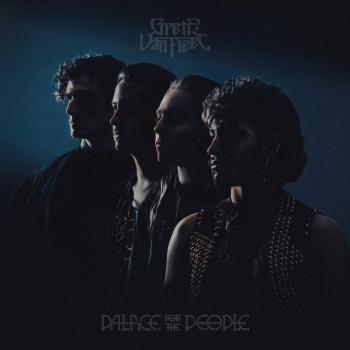


[].
Close Ties (Remastered) Gene Bertoncini & Michael Moore
Album Info
Album Veröffentlichung:
1987
HRA-Veröffentlichung:
09.10.2026
Label: Jazz Heritage Society
Genre: Jazz
Subgenre: Crossover Jazz
Interpret: Gene Bertoncini & Michael Moore
Das Album enthält Albumcover
- 1 Pavane/The Lamp is Low 05:15
- 2 Lush Life/Isfahan 07:18
- 3 Siciliano/Waltz 06:10
- 4 Prelude No. 2 07:46
- 5 Mood Indigo 04:11
- 6 Vocalise 05:13
Info zu Close Ties (Remastered)
The plucking of guitar strings and the bowing of a bass—what kind of music would that make? It makes very smooth music indeed, in the case of Close Ties, a collaborative effort between guitarist Gene Bertoncini and bassist Michael Moore. What they play is jazz, but it is a subdued, elegant sort of jazz that frequently makes excursions across the border into classical terrain and back again.
Gene thinks of the guitar as a keyboard instrument where the left and right hands function independently almost as they do at a piano. He has been coaxing jazz out of guitars since his days as an architecture student at Notre Dame back in the '50s. He plays primarily a classical guitar with nylon strings, relying on the microphone for amplification, and occasionally an amplified guitar.
The instrument that Gene Bertoncini plays can trace its ancestry back all the way to Babylon and Egypt. Words similar to guitar can be found in the medieval literature of Europe. The instruments of the 16th and 17th centuries were smaller than the ones we know today; it was in Italy during the 17th century that the guitar became a five- stringed instrument, acquiring its sixth string around 1780.
Bertoncini's instrument has six strings. The guitar was out of fashion for a while until Segovia made it world famous as a classical instrument in our time and induced some of the greatest composers of the 20th century to write for it. As you can hear on this release, when it is controlled by the right fingers it can also be an ideal medium (as Charlie Byrd discovered) for interpreting jazz. And what of the bass? The double bass has been around since the 15th century. Its job from about 1600 has been to supply the lowest sounds to be heard in polyphonic compositions. Under the ministrations of a player like Michael Moore it becomes the medium for supplying the melody while Bertoncini strums the guitar in improvisatory elaborations.
Here's what Bertoncini says of his partner's role as bassist in their collaborations: "Michael...is one of the finest jazz musicians alive on any instrument. And he’s a wonderful accompanist. He has a superb sense of what to play behind you. His timing is impeccable, magnificent. And as for his bowing, I think he is the finest arco player in the field. This makes it possible for me to accompany him in turn. He adds: “Michael has this constant concern for melody, swing, and space.” The same sort of praise has been accorded Bertoncini’s guitar playing.
Gene Bertoncini, guitar
Michael Moor, bass
Recorded at DiGangi Studios, Emerson, New Jersey
Mastered at Executive Sound Studios
Digitally remastered

Gene Bertoncini
An eloquent and versatile improviser, Mr. Bertoncini has been heard with an extraordinary range of jazz greats, including performances and recordings with Benny Goodman, Buddy Rich, Wayne Shorter, Hubert Laws, Paul Desmond among others, as well as such distinguished singers as Tony Bennett, Lena Horne, Nancy Wilson, Vic Damone, and Eydie Gorme.
The Washington Post proclaimed his solo appearance in New York City the best jazz concert of the year 1999. Mr. Bertoncini’s acclaim is hardly confined to this country. His CD, “Someone to Light Up My Life” which features his own arrangements of the compositions of the great bossa nova composer Antonio Carlos Jobim, won international raves. Brazilian critic’s and listener’s polls also named him the best acoustic jazz guitarist. Gene Bertoncini has just released a striking new solo CD, “Quiet Now” on the heels of his highly successful “Acoustic Romance,” which reached the top ten of the jazz playlists. Jazziz magazine’s March 2004 issue ranked it Number 1 in their list of the top 20 acoustic guitar CDs.
His newer cds: “Concerti” features Gene with a string quartet and bass; “Reunion” with Michael Mainieri, Michael Moore, Joe Corsello and “Joy” with Clay Jenkins and Ike Sturm. A prolific and popular studio musician, Bertoncini honed his professional chops as a member of the Tonight Show band during Johnny Carson’s tenure, and he has worked with composers and arrangers such as Lalo Schifrin and Michael Legrand and has performed with the Metropolitan Opera Orchestra.
In addition to an active performing and recording schedule, Gene teaches at the Eastman School of Music and William Patterson University. A New York City native, he graduated from the University of Notre Dame ‘59 with a degree in architecture. According to the New Yorker magazine, “Bertoncini is an affecting, highly original guitarist that moves easily back and forth between classical and jazz guitar.”
Gene was nominated as the best jazz guitarist of the year (09) by the New York Jazz Press Association.
On January 20th, 2017, Gene Bertoncini received a distinguished award from the University of Notre Dame honoring his achievements in the performing arts. The Rev. Arthur S. Harvey, C.S.C., Award recognizes Gene’s distinguished work as a jazz musician.
Michael Moor
was born in Cincinnati, Ohio and studied bass with Frank Proto, Harold Roberts and Orin OBrien. Of Michaels talents John Wilson, writing in The New York Times, writes "...one of the most consistently brilliant bassists in recent history." At the age of 20, after joining the Woody Herman Band, Michael became an integral part of the New York jazz scene. His work has included recordings and live performances with Marian McPartland, Bill Evans, Stan Getz, Chet Baker, Gary Burton, Jim Hall, Zoot Sims, Jimmy Rowles, Gene Bertoncini, Jack Wilkens, Benny Goodman, Ruby Braff, Jimmy Raney, Freddie Hubbard, Lee Konitz, Tony Bennett, John Scoeld, Bob Brookmeyer and Gil Evans. Much in demand by instrumentalists and singers world wide, Michael continues to be an innovator and prolific composer. In a feature article in The New Yorker Whitney Balliett writes "...Moore lifts his listeners into the realm of pure melody ... he has an unfailing and always surprising rhythmic sense..."
Dieses Album enthält kein Booklet