


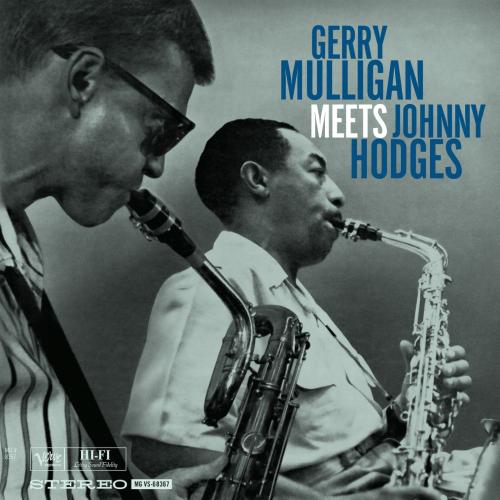
Gerry Mulligan Meets Johnny Hodges (Remastered) Gerry Mulligan & Johnny Hodges
Album Info
Album Veröffentlichung:
2026
HRA-Veröffentlichung:
13.02.2026
Das Album enthält Albumcover
Entschuldigen Sie bitte!
Sehr geehrter HIGHRESAUDIO Besucher,
leider kann das Album zurzeit aufgrund von Länder- und Lizenzbeschränkungen nicht gekauft werden oder uns liegt der offizielle Veröffentlichungstermin für Ihr Land noch nicht vor. Wir aktualisieren unsere Veröffentlichungstermine ein- bis zweimal die Woche. Bitte schauen Sie ab und zu mal wieder rein.
Wir empfehlen Ihnen das Album auf Ihre Merkliste zu setzen.
Wir bedanken uns für Ihr Verständnis und Ihre Geduld.
Ihr, HIGHRESAUDIO
- 1 Bunny (Remastered) 05:43
- 2 What's The Rush (Remastered) 03:42
- 3 Back Beat (Remastered) 07:27
- 4 What It's All About (Remastered) 04:01
- 5 18 Carrots For Rabbit (Remastered) 05:14
- 6 Shady Side (Remastered) 07:04
Info zu Gerry Mulligan Meets Johnny Hodges (Remastered)
Recorded in 1959, Gerry Mulligan Meets Johnny Hodges is heralded as one of the best of Mulligan's recorded pairings with fellow instrumentalists. On this date, the two saxophonists are joined by a solid rhythm section of Claude Williamson (piano), Buddy Clark (bass) and Mel Lewis (drums), splitting the repertoire across three originals each from Mulligan and Hodges. The two complement the other throughout with the exception of Mulligan's "What's the Rush," where the baritonist sits out altogether in favor of Hodges' alto taking the spotlight.
“This is the kind of session about which critical comment is a waste of space. The two men blend just the way you would expect a rabbit to blend with a carrot-top. Casual, unostentatious music that belongs irrevocably to the past, present and future of jazz. (Leonard Feather, DownBeat)
"Gerry Mulligan's 1959 studio date with Johnny Hodges is one of the most satisfying sessions of his various meetings with different saxophonists for Verve, yet it was inexplicably the last to be made available on CD. With a hand-picked rhythm section consisting of pianist Claude Williamson, bassist Buddy Clark, and drummer Mel Lewis, and three originals contributed by each of the two leaders, everything gels nicely, though several tracks took more than three takes (in spite of liner note writer Nat Hentoff's assertions) to reach their final form. Mulligan contributed the gorgeous ballad "What's the Rush" (where he sat back to enjoy Hodges' solo and never plays his own horn), the easygoing swinger "Bunny," and the brisk cooker "18 Carrots (For Rabbit)," the latter which its composer would revisit with his Concert Jazz Band. The veteran alto saxophonist contributed the low-key ballad "Shady Side," the sassy blues "Back Beat" (later re-recorded by Hodges during a still unreleased 1960 studio meeting with Ben Webster), and "What It's All About," another potent blues. Throughout the date, the two saxophonists blend beautifully and complement one another's efforts, even though this was their only opportunity to record together in the studio. Sadly, no alternate takes or unissued numbers (at least two of which exist) have been added to this long anticipated reissue." (Ken Dryden, AMG)
Gerry Mulligan, baritone saxophone
Johnny Hodges, alto saxophone
Claude Williamson, piano
Buddy Clark, bass
Mel Lewis, drums
Digitally remastered
Gerry Mulligan
was born in 1927 in Queens Village, New York. His father was an engineer, so the family constantly relocated all over the United States when Gerry was a boy. Eventually the family settled in Reading, Pennsylvania when Gerry Mulligan was 14, and that is where he started to play music. He started first on the clarinet, but soon switched to saxophone and was playing gigs with dance bands 100 miles away in Philadelphia. Gerry moved to New York City in 1946, and eventually started to live with Gil Evans on 55th street. During this time he would collaborate with the likes of Gene Krupa, Lee Konitz, and Miles Davis. He was also considered a serious arranger, and often arranged songs for the Gene Krupa Band. Gerry Mulligan's style is laid back and melodic, with a large influence from Lester Young, but a slick and staggering command of bebop, Gerry Mulligan truly found his own niche as an improviser and arranger. Eventually Gerry Mulligan would relocate to the west coast, and make some of his most well known recordings in his piano-less quartet with Chet Baker. He would continue to play and record regularly until his death in 1995. Some of the musicians that he played with in his lifetime are, Stan Getz, Bob Brookmeyer, Dave Brubeck, Wallace Roney, Art Farmer, Teddy Wilson, Thelonious Monk, Paul Desmond, and Johnny Hodges. (jazzempowers.org)
John Cornelius "Johnny" Hodges
was born July 25, 1907 in Cambridge, Massachusetts, to John H. Hodges and Katie Swan Hodges. While known as a saxophone player, Hodges began as a self-taught pianist and drummer. His professional career began when he was a teen, playing piano at dances in private homes for $8 an evening. At the age of 14, his sister introduced him to Sidney Bechet, revered American saxophonist and clarinetist, who began giving Hodges private lessons. Hodges honed his skills and became well-known in Boston before moving to New York City in 1924.
In New York, Hodges began playing with many of the greats. He was in bands led by legends such as Lloyd Scott, Chick Webb, Bobby Sawyer, and Luckey Roberts. The band he is most closely associated with though, he joined in 1928: Duke Ellington’s Orchestra. Hodges was a pivotal part of Duke’s band, not only as an alto sax soloist but as a co-writer on several of Ellington’s records. He toured with Ellington’s band in Europe in the 1930s. In the late 30s and early 40s, he recorded many well-known songs with the group such as In a Sentimental Mood, Things Ain’t What They Used to Be and The Jeep Is Jumpin’ (Jeep was one of Hodge’s nicknames). In New York, Hodges also met his first wife Bertha Pettiford and had his son, John C. Hodges II. In 1944, Hodges was re-married to Edith Cue, a dancer in the Cotton Club chorus. They had a daughter, Lorna Lee.
In 1951, Hodges left Duke Ellington’s Orchestra to create his own small group: Johnny Hodges and His Orchestra. Many greats played in his band such as Lawrence Brown, Sonny Greer, and John Coltrane. One of the group’s most well-received records was Castle Rock, the title track was a hit song. In 1955, Hodges rejoined Ellington’s group but continued to record and perform under his own name as well. He recorded several joint albums with Ellington such as Duke Ellington And Johnny Hodges Play The Blues – Back To Back and Duke Ellington And Johnny Hodges Side by Side. He continued to work with greats such as Frank Sinatra, Wild Bill Davis, and Ben Webster.
In 1970, Johnny Hodges performed at the Imperial Room in Toronto. Less than a week later, on May 11, 1970, he died of a heart attack while visiting the office of a dental surgeon. At Hodges’ funeral, Duke Ellington was quoted saying "Never the world's most highly animated showman or greatest stage personality, but a tone so beautiful it sometimes brought tears to the eyes—this was Johnny Hodges. This is Johnny Hodges." Hodge’s melodies were distinct and integral to the sound he brought to Ellington’s band and his own groups. His technique and harmonic sense were unmatched and kept his solos sounding contemporary, no matter where or when he was playing. (jazzattackswings.com)
Dieses Album enthält kein Booklet