




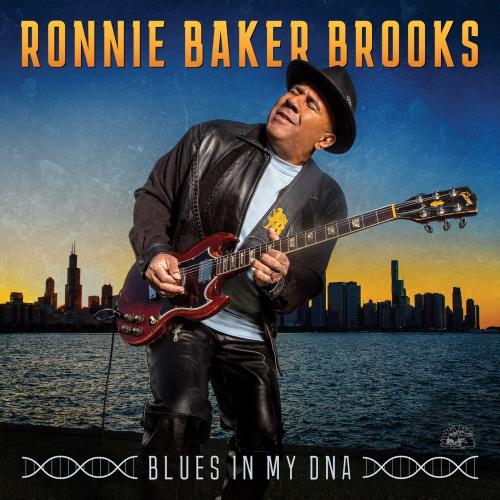
Blues In My DNA Ronnie Baker Brooks
Album Info
Album Veröffentlichung:
2024
HRA-Veröffentlichung:
18.03.2026
Das Album enthält Albumcover
- 1 I'm Feeling You 04:37
- 2 Lonnie Brooks' Blessing 00:14
- 3 Blues In My DNA 04:48
- 4 My Love Will Make You Do Right 04:39
- 5 Accept My Love 04:24
- 6 All True Man 04:10
- 7 Robbing Peter To Pay Paul 04:15
- 8 Instant Gratification 03:59
- 9 I Got To Make You Mine 04:12
- 10 Stuck On Stupid 08:12
- 11 I Found A Dollar Looking For A Dime 04:52
- 12 My Boo 03:39
Info zu Blues In My DNA
An up-to-the-minute, organic masterpiece, firmly rooted in the blues while unearthing fertile new ground, all fueled by Ronnie’s passionate vocals and commanding guitar work. Produced by Jim Gaines (Santana, Stevie Ray Vaughan, Luther Allison, Lonnie Brooks), the album features all-original material that moves effortlessly from funkified blues-rock to aching Memphis soul to hypnotic, deep-in-the-pocket raw blues.
"In Ronnie Baker Brooks’ powerhouse hands, blues-rock never sounded so outrageous. Soul never sounded so delicious. And the blues never sounded so profound…one of today’s top live performers." (Blues Music Magazine)
There’s no hiding the pride beaming from Ronnie Baker Brooks’ face on the cover of Blues In My DNA, his fifth career album but his first for Alligator Records. You can see his satisfaction at being pictured on the lakefront of Chicago, the city where he was introduced to the blues as a child. Ronnie is even playing the same guitar his father Lonnie Brooks cradled (and shot lightning bolts from!) on the cover of Bayou Lightning, Lonnie’s 1979 Alligator debut.
The full circle moment is one Ronnie has been working toward his entire life. Blues In My DNA confirms Ronnie’s status as a premier Chicago bluesman whose songwriting speaks directly to the current moment, but whose influences—like those of his father—span Memphis soul, rock ‘n’ roll, funk, and hard-charging Chicago blues. Joining Alligator means being on a label originally defined by artists of his father’s generation—Albert Collins, Koko Taylor, Eddy Clearwater, and of course Lonnie himself—who also served as direct mentors to Ronnie since he was old enough to hold a guitar.
He always knew that becoming an Alligator artist would not just be a way to honor his family legacy, but to also do something even more profound—to serve as a bridge to the next generation by reaching a larger audience. “If I can be a link to the chain that inspires someone to love the music that has been so good to me and so healing for me, then my mission is accomplished,” he says.
Like most people, the Covid-19 pandemic forced a reset to Ronnie’s life and career. Until then, he had paved his own way as both a road warrior and independent label operator, having established a global audience through tours that took him around the world, and three critically-acclaimed albums issued on his own Watchdog Records. “I started with a mailing list that came from my shows. I would physically mail fans notifications about when a new record was coming out and they would buy them. Then I took that money and flipped it and back into the next record,” he remembers.
After the release of Times Have Changed, an acclaimed album on the Provogue label recorded in Memphis with producer-drummer Steve Jordan (The Rolling Stones), the album title proved prophetic. Lonnie Brooks died not long after the album’s release. Then came the pandemic. Touring, the lifeblood for Ronnie’s family, braked indefinitely. Life as he knew it was suddenly uncertain. “It was scary. It was the first time I had to go through a major life event without my dad,” he recalls.
Gradually, Ronnie reengineered his performing life to weekly Facebook concerts. “The blues is a healer,” he explains, and social media “gave me a lifeline.” With those shows picking up steam—he discovered people tuning in from all parts of the world—Ronnie started working out new songs to introduce to his new online audience. The weekly deadline heightened the intensity in his writing sessions, forcing him to reflect on where he was in his life, what he had inherited, and the responsibilities that follow.
The song "Blues In My DNA" is the culmination of all those things. His father’s voice introduces the song—“I give you my blessing to keep these blues alive,” Lonnie says—followed by a heavy guitar riff that frames a complex testimonial about personal perseverance (“I didn’t know we had no money/because we were rich with pure love”), the struggle to confront legacy racism (“I can feel the pain from the chains/from what my ancestors been through”) and the strength to move forward (“keeping faith with every piece I break of this invisible glass ceiling”). To date, it is the most personal song Ronnie has committed to record. “It’s a tough story to tell. I’m singing, ‘I’m not complaining, Lord, I’m just explaining’ and that’s the truth. I’m just trying to tell the story and stay authentic to the blues in my life,” he says.
The rest of the album spans genres as it does personal themes. The soul ballad "Accept My Love" transports Brooks to memories of his mother Jeannine Baker, who died in 2023. “I wasn’t even thinking about my mom when I wrote it, but soon as the organ part came in, my mom came to me,” he says. The classic blues shuffle "Robbing Peter To Pay Paul," humorously looks at the struggles of trying to stay ahead while "Instant Gratification," a heavy rocker, captures the anxiety of needing satisfaction when running against the clock.
Above all else, Blues In My DNA is a testament to how Ronnie is translating his personal history to new audiences who haven’t walked in his shoes. “I’m on a journey,” he states. “When I decided to make this my career, it was to do whatever I can to elevate, not just the blues, but the legacy that’s in my DNA.” (Mark Guarino)
Ronnie Baker Brooks, vocals, electric guitar
Will McFarlane, rhythm guitar
Dave Smith, bass
Steve Potts, drums
Additional musicians:
Lonnie Brooks, vocals (track 2)
Rick Steff, electric piano (tracks 3, 4, 6, 7, 8, 9, 11, 12)
Clayton Ivey, Hammond B3 Organ (tracks 4, 5, 8, 9, 10)
Brad Quinn, tenor and baritone saxophone (tracks 5, 8)
Drew White, trumpet (tracks 5, 8)
Trenicia Hodges, background vocals (track 9)
Kimberlie Helton, background vocals (track 9)
Recorded and mixed by Jim Gaines at Bessie Blue Studios, Pickwick Dam, TN
Additional Recording by Jimmy Nutt at The Nutt House, Muscle Shoals, AL
Mastered by Collin Jordan, Bruce Iglauer and Ronnie Baker Brooks at The Boiler Room, Chicago, IL
Produced by Jim Gaines
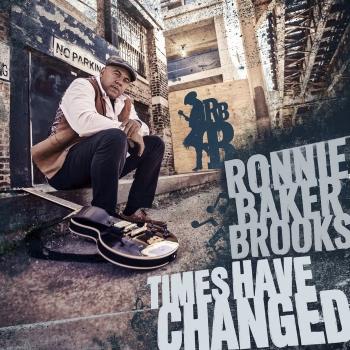

Ronnie Baker Brooks
On the first day recording Times Have Changed - the eleven-track album from Chicago bluesman Ronnie Baker Brooks that brings a sound so big it could topple a Louisiana juke joint - industry-revered album producer and drummer Steve Jordan told Brooks to put his pedal board back in the van. For the first time in his professional life, Brooks, the son of Texas and Chicago blues legend Lonnie "Guitar Jr." Brooks, would plug a Gibson into TKTK amp and rip it straight from there.
"Back to the basics. The pedals get in the way of your tone – your natural tone. Any distortion I had came straight out of the amp." Brooks remembers from the Times sessions. "It was almost like going to college, or grad school. It was definitely an education."
Brooks, 49, likes to treat each album he makes as a platform for him to grow, but the reality is that he's been climbing the blues world's latter all his life. He was born in Chicago, and started playing guitar around age six. At 19, he joined his father, who by then had influenced some of the most well-known bluesman of our history: Jimmy Reed, the Fabulous Thunderbirds, Johnny Winter, and Junior Wells. For 12 years the two would tour together, putting Ronnie out front with Eric Clapton, B.B. King, Buddy Guy, and Koko Taylor. In 1998, when he was 32, his father told him to go solo.
Baker already had a band by then, one he'd been touring on the side with since 1992. But by 1998 he'd started a label; that year he made his first album, Golddigger, 16 songs tracked out in two weeks. "My dad always said to keep writing, even if you don't think the song sounds great or you can't finish it," says Baker. "Write. Continue to write. The more you write, the better you get." Take Me Witcha came three years later; his second album on Watchdog Records. Brooks broke out as his own champion on 2006's The Torch. The Boston Herald called it "ferocious and unrelenting … the year's best blues album."
In the ten years since The Torch, Brooks has started a family, toured North America and Europe, and taken feature spots on the records of other bluesmen. He produced Eddy Clearwater's West Side Strut and contributed guitar work to albums from Elvin Bishop, the Legendary Rhythm & Blues Review, Billy Branch, and Big Head Todd.
Times Have Changed, Brooks' first album in ten years, carries with it the weight of grown perspective and time spent perfecting old material. Brooks worked it with Steve Jordan, whose work runs from Keith Richards to Stevie Wonder, John Mayer and Eric Clapton. With that comes a lesson in rhythm and blues history. Brooks refers to the director as "a walking encyclopedia of music detail and equipment", a professor through which Brooks could take that next developmental step. "Once we got the ball rolling, my confidence went higher and higher", he says. "I'm a better musician for this experience."
The experience Brooks is talking about is that which came together over the course of a few weeks at Royal Studios in Memphis, the home of Al Green, Syl Johnson and Bobby "Blue" Bland. Jordan and Brooks brought in a mint press of Memphis music royalty: Stax Records staple Steve Cropper (Booker T. & the M.G.'s, Otis Redding, Sam & Dave), Archie Turner (Al Green, Syl Johnson, O.V. Wright), jazz saxophonist Lannie McMillan, and R&B icon Angie Stone. For several tracks, Brooks also enlisted brothers Teenie (guitar), Charles (organ) and Leroy Hodges (bass) of the legendary Hi Rhythm Section, which served as the house band for hit soul albums by artists like Al Green and Ann Peebles. "We used the same mics that Al Green used on his record", says Brooks. "Matter of fact, we were using much of the same band! It kind of took that vibe." The first track recorded was a cover of Curtis Mayfield's Superfly hit Give Me Your Love. The second, Twine Time, the instrumental jam from Alvin Cash.
"To be honest with you, when Steve said 'Man, we need an instrumental,' the first person I thought of was Freddie King. Steve wanted something more appealing to all people, not just guitar players. He said 'What about Twine Time?'' I said, 'Is he serious?' Yeah, Twine Time. But that song was a key to this album. Man, that just lit the fire for this record. It became one of the funnest tracks we did."
'Times' also comes laden with original hits. Five of the eleven tracks were penned by Brooks. Raised on others' music, he's always considered the songwriting process to be as sacred. "It's like having a baby", he says. "You see it come to life. Once you play it live, it grows even more. That was the most fun part of it, for me: the creative side. Coming up with a song people can relate to, and you relate to, it just snowballs. It's almost like therapy for me. Like the song Times Have Changed: I wrote that song years ago. I sent Steve my songs and he picked that one. It's kind of timeless. Every day something's changing. Now, when I play it live, you can see the effect of it. Initially, it was just an idea: just a riff. Now, this song has influence on people. We were just in Europe this year, after the bombing in Brussels. And we're playing Brussels. I played that song; people were in tears. It helped them heal."
It's on that title track that Brooks brandishes what may be his finest songwriting talent: the ability to humanize social issues and unite different voices into one cohesive thought. That's no more evident than in the latter stages of the song, in which Brooks deploys his longtime friend, Memphis' Al Kapone, to drop 32 bars on what the future holds for our people.
"My whole intention, when I started with Golddigger and up through this one, was to be authentic enough for the older generation but have something that the younger generation could latch onto," says Brooks. "I try to be that bridge. With Take Me Witcha, I've got a rapper on that. On The Torch we went with Al Kapone. He's a bridge. He's a bridge from blues to hip-hop. With music, it all comes from the heart. It comes from the heart and from the soul. In blues, it doesn't matter what you're talking about, it definitely relates.
"That was my intention on this record: to build that bridge."
Dieses Album enthält kein Booklet