




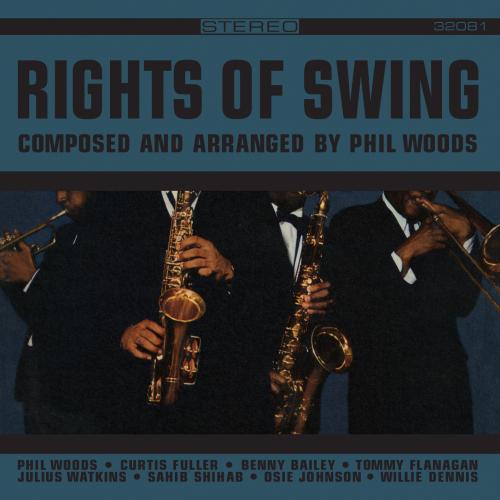
Rights Of Swing (Remastered) Woods, Fuller, Bailey, Flanagan, Watkins, Shihab, Johnson, Dennis
Album Info
Album Veröffentlichung:
2023
HRA-Veröffentlichung:
06.03.2026
Label: Candid
Genre: Jazz
Subgenre: Hard Bop
Interpret: Woods, Fuller, Bailey, Flanagan, Watkins, Shihab, Johnson, Dennis
Das Album enthält Albumcover
- 1 Prelude And Part 1 (Remastered) 06:37
- 2 Part II (Ballad) (Remastered) 07:45
- 3 Part III (Waltz) (Remastered) 05:44
- 4 Part IV (Scherzo) (Remastered) 11:28
- 5 Part V (Presto) (Remastered) 07:17
Info zu Rights Of Swing (Remastered)
Als Phil Woods zum ersten Mal auf der Bildfläche erschien, wurde er oft als „The New Bird“ bezeichnet, in Anlehnung an den legendären Charlie Parker – ein Beweis für sein Genie am Saxophon, ganz sicher. Aber obwohl er Parker offensichtlich viel zu verdanken hatte – wie alle modernen Jazz-Saxophonisten einer bestimmten Ära –, steht außer Frage, dass Phil Woods ein Original war. Nachdem er Anfang der 1950er Jahre einen Abschluss in Musik an der Juilliard School erworben hatte, geriet Woods in den Bannkreis des großen Quincy Jones. Auf Einladung von Jones schloss sich Woods Dizzy Gillespies berühmt-berüchtigten Jazz Ambassadors an – einer vom US-Außenministerium im Rahmen einer globalen Kulturdiplomatie-Initiative gesponserten Tournee – und wurde anschließend Mitglied von Jones' eigener Tournee-Band. Diese Aufnahme, sein neuntes Album als Bandleader, besteht ausschließlich aus Woods' fünfteiliger Rights of Swing Suite. Eine ambitionierte, groß angelegte Komposition, die fest in der Jazztradition verankert ist. Eine Kulmination der Einflüsse, die der damals 30-jährige Künstler aufgenommen hatte. Die Platte gilt als eine der besten Aufnahmen von Woods und enthält eine herausragende Sektion, die sich aus Woods' Kollegen aus der Quincy-Jones-Band zusammensetzt. (Es sei darauf hingewiesen, dass dieselben Musiker größtenteils auch die Sektion auf Benny Baileys Candid-Records-Aufnahme „Big Brass“ bilden, die einige Monate zuvor, im November 1960, aufgenommen wurde).
„Woods hatte eine verlockende Mischung aus Stimmen geschaffen und dabei das Beste aus der ungewöhnlichen Kombination von Alt, Trompete, Bariton, Posaune (Curtis Fuller) und Waldhorn gemacht. Julius Watkins ist etwas Besonderes. Er holt das Beste aus einem schwerfälligen Jazzinstrument heraus und ist mit seinem samtigen und satinartigen Anschlag der Star unter seinen Sektionskollegen. Wenn er Soli spielt, klingt das so süß und natürlich, als würde man einem Baby beim Stillen zusehen. Muttermilch und all das. Ein schöner Kontrast zu Woods, der die längsten Soli spielt, in Höchstform ist und die Feuerwehr in Angst und Schrecken versetzt. Bei aller Leidenschaft lässt er seine fließenden Linien atmen und untermalt sie oft mit einem Stöhnen und einem Schrei. (flophousemagazine.com)
Phil Woods, Altsaxophon
Sahib Shihab, Baritonsaxophon
Benny Bailey, Trompete
Curtis Fuller, Posaune (Tracks 1-4)
Willie Dennis, Posaune (Track 5)
Julius Watkins, Waldhorn
Tommy Flanagan, Klavier
Buddy Catlett, Kontrabass
Osie Johnson, Schlagzeug (Tracks 1-4)
Granville Roker, Schlagzeug (Track 5)
Aufgenommen am 26. Januar und 10. Februar 1961 in den Nola Penthouse Sound Studios, New York City
Toningenieur: Bob d’Orleans
Produziert von Nat Hentoff
Digital remastered von Bernie Grundman
Phil Woods
One of the true masters of the bop vocabulary, Phil Woods has had his own sound since the mid-’50s and stuck to his musical guns throughout a remarkably productive career. There has never been a doubt that he is one of the top alto saxophonists alive, and he has lost neither his enthusiasm nor his creativity through the years.
Woods’ first alto was left to him by an uncle, and he started playing seriously when he was 12. He gigged and studied locally until 1948, when he moved to New York. Woods studied with Lennie Tristano, at the Manhattan School of Music, and at Juilliard, where he majored in clarinet. He worked with Charlie Barnet (1954), Jimmy Raney (1955), George Wallington, the Dizzy Gillespie Orchestra, Buddy Rich (1958-1959), Quincy Jones (1959-1961), and Benny Goodman (for BG’s famous 1962 tour of the Soviet Union), but has mostly headed his own groups since 1955, including co-leadership of a combo with fellow altoist Gene Quill in the ’50s logically known as “Phil & Quill.” Woods, who married the late Charlie Parker’s former wife Chan in the 1950s (and became the stepfather to singer Kim Parker), was sometimes thought of as “the new Bird” due to his brilliance in bop settings, but he never really sounded like a copy of Parker.
Woods popped up in a variety of settings in the 1960s — on Benny Carter’s classic Further Definitions record, touring Europe with the short-lived Thelonious Monk Nonet, and appearing on studio dates like the soundtracks to The Hustler and Blow Up. Always interested in jazz education (although he believes that there is no better way to learn jazz than to gig and travel constantly), Woods taught at an arts camp in Pennsylvania in the summers of 1964-1967. Discouraged with the jazz scene in the U.S., he moved to France in 1968. For the next few years, Woods led a very advanced group, the European Rhythm Machine, which leaned toward the avant-garde and included pianist George Gruntz. Their recordings still sound fresh and exciting today, although this venture would only be a detour in Woods’ bebop life. In 1972, he returned to the U.S. and tried unsuccessfully to lead an electronic group that featured keyboardist Pete Robinson.
In 1973, Woods formed a quintet with pianist Mike Melillo, bassist Steve Gilmore, drummer Bill Goodwin, and guitarist Harry Leahey that had much greater success. Their recording Live at the Showboat officially launched the band, which today, after a few personnel changes, still tours the world. After Leahey left in 1978, it was known as the Phil Woods Quartet until trumpeter Tom Harrell (1983-1989) joined; his spot has since been assumed by trombonist Hal Crook (1989-1992) and trumpeter Brian Lynch. Pianist Melillo went out on his own in 1980, and his successors have been Hal Galper (1980-1990), Jim McNeely (1990-1995), and Bill Charlap; Gilmore and Goodwin have been with Woods since the group’s start. Not just a bebop repertory band, Woods’ ensembles have developed their own repertoire, taken plenty of chances, and stretched themselves while sticking to his straight-ahead path.
Woods contributed the famous alto solo to Billy Joel’s hit recording of “Just the Way You Are” and has been one of Michel Legrand’s favorite artists, guesting with Legrand on an occasional basis; he has made dozens of rewarding recordings himself through the years. He debuted as a leader in 1954 and has since recorded for Prestige, Savoy, RCA, Mode, Epic, Candid (the brilliant The Right of Swing in 1961), Impulse, MGM, Verve, Embryo, Testament, Muse, Omnisound, Enja, and Chesky, and has recorded with his Quintet/Quartet for RCA, Gryphon, Adelphi, Clean Cuts, SeaBreeze (two sets adding Chris Swansen’s inventive synthesizer to the band), Red, Antilles, Palo Alto, BlackHawk, Denon, and quite extensively for Concord. Some key sets include 1960’s Rights of Swing on Candid, 1974’s Musique Du Bois on 32 Jazz, 1981’s Birds of a Feather from Antilles, and 2002’s Americans Swinging in Paris from EMI.
An Italian label, Philogy (which has some broadcasts and live performances from Woods’ bands), is named after the popular and still brilliant altoist. Still going strong well into the 21st century, Woods cut a live session with the Los Angeles Jazz Orchestra in 2005 that was released by Jazz Media in 2006. American Songbook, which features Woods’ treatment of pop and jazz standards, appeared from Kind of Blue later that same year. In 2009, after years of attempting to secure the rights to interpret the work of writer A.A. Milne, Woods released Children’s Suite — a tribute to Milne’s classic book Winnie the Pooh. (Scott Yanow, AMG)
Dieses Album enthält kein Booklet