






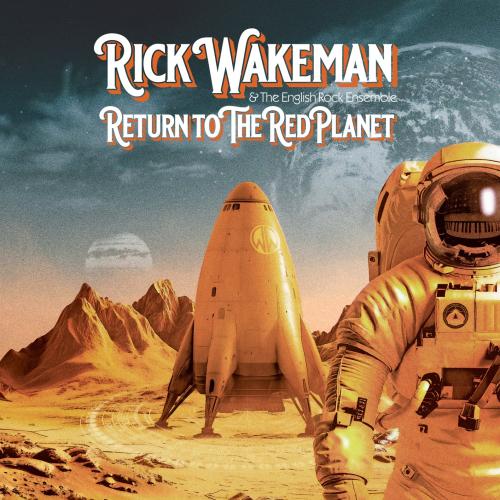
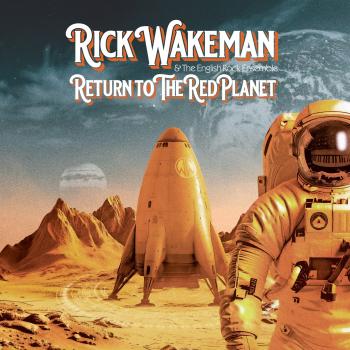
Return To The Red Planet Rick Wakeman
Album info
Album-Release:
2026
HRA-Release:
25.09.2026
Album including Album cover
- 1 The Jezero Crater 06:58
- 2 Bowie's Vision 05:48
- 3 Noctis Labyrinthus 05:31
- 4 Noachis Terra (Land of Noah) 06:24
- 5 Witch Hazel Hill 04:02
- 6 St Paul's Bay 06:55
- 7 Martian Dust Devils 04:56
- 8 Medussae Fossae 04:29
- 9 The Epochs of Mars 07:45
Info for Return To The Red Planet
Following his acclaimed 2020 album The Red Planet, Rick Wakeman makes a triumphant and inevitable return to Mars with Return to The Red Planet, a sweeping new progressive work that fuses science, imagination, and musical virtuosity into one of the most ambitious recordings of his career.
At a time when space exploration has moved back to the forefront of human endeavour - with missions to the Moon, Mars and beyond, once again capturing the world’s imagination - Return to The Red Planet feels both timely and visionary, rekindling the cosmic spirit that helped define progressive rock’s golden age.
Where its predecessor opened the story, this album explores the planet’s ancient lakes, vast canyon systems, shifting dust storms, and geological epochs, drawing directly on the remarkable images and research that have transformed our understanding of Mars in recent years, Wakeman immersing himself in planetary research, data, and mission reports before a single note was written.
"Once I started looking at the new data and photographs, I realised there was an entirely new album waiting to be written. There was simply too much more to say about Mars - musically and spiritually - not to return." - Rick Wakeman
Recorded between August 2025 and January 2026, the project also marks a welcome return to full band recording, with all musicians working together at Decoy Studios - a creative approach Wakeman considers essential to capturing the spontaneity and energy of progressive rock at its best.
The album is performed by Wakeman’s English Rock Ensemble, featuring bassist Lee Pomeroy, guitarist Dave Colquhoun, drummer Adam Falkner, and vocalist Mollie Marriott, daughter of legendary Steve Marriott. The album was mastered by renowned engineer Simon Heyworth.
"This isn't just another Rick Wakeman album. It's a bloody good one!" - Simon Heyworth Producer of Tubular Bells
Among the album's centrepieces is Bowie’s Vision, a deeply personal homage to Wakeman's friend David Bowie, whose fascination with Mars helped shape popular culture's image of the planet. The connection is more than thematic: Wakeman performed the iconic piano on Bowie’s Life on Mars?, making this tribute both musical and autobiographical - a reflection on a shared history, a lasting friendship, and one of rock’s most celebrated recordings.
The music was initially composed as keyboard "templates" at Nursery Studios, before being expanded collaboratively by the band at Decoy Studios and engineered by Toby Wood. Final overdubs and mixing with producer/engineer Erik Jordan bring the vision into sharp focus - from sweeping symphonic passages to intricate rhythmic sequences and haunting choral textures.
"An astonishing return to form...Wakeman at his most imaginative" - Prog Magazine
"A richly detailed symphonic rock journey" - Classic Rock
Rick Wakeman, keyboards
Dave Colquhoun, guitars
Lee Pomeroy, bass
Adam Falkner, drums
Mollie Marriott, vocals



Rick Wakeman
Born in Perivale, Middlesex, England, Rick Wakeman's interest in music manifested itself very early, and from the age of seven on he studied classical piano. At the age of 14, he joined a local band, Atlantic Blues, the same year he left school to enroll in the Royal College of Music. He had his eye on a career as a concert pianist, but Wakeman was dismissed from the college after it became clear that he preferred playing in clubs to studying technique.
By his late teens, he was an established session man, playing on records by such diverse acts as Black Sabbath, Brotherhood of Man, and Edison Lighthouse. At the end of the '60s, his name also began appearing on the credits of albums by such artists as Al Stewart and David Bowie, and one set of sessions with a folk-rock band called the Strawbs led to his joining the group in 1970. After two albums with the Strawbs, Wakeman joined Yes, a post-psychedelic hard rock band that had attracted considerable attention with their first three albums. Wakeman played a key role in the final shape of the group's fourth record, Fragile, creating a fierce, swirling sound on an array of electric and acoustic pianos, synthesizers, and Mellotrons. Fragile was a hit, driven by the chart success of the single "Roundabout," and Wakeman was suddenly elevated to star status.
This album contains no booklet.