
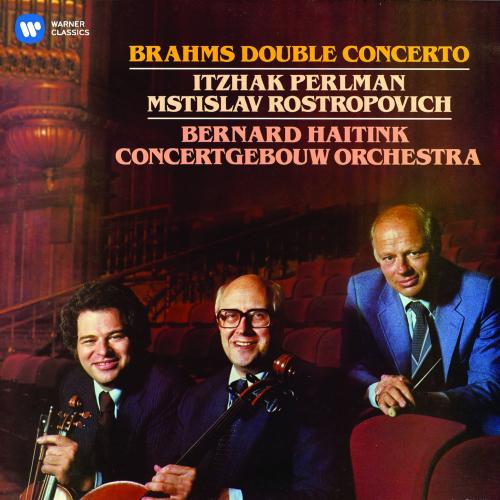
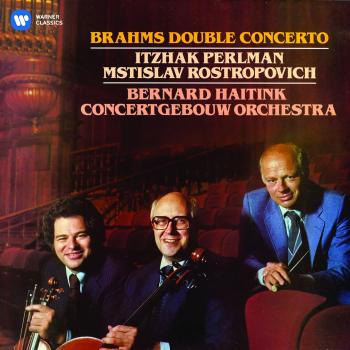
Brahms: Double Concerto, Op. 102 Itzhak Perlman, Mstislav Rostropovich, Concertgebouworkest & Bernard Haitink
Album info
Album-Release:
2017
HRA-Release:
16.10.2026
Label: Warner Classics
Genre: Classical
Subgenre: Concertos
Artist: Itzhak Perlman, Mstislav Rostropovich, Concertgebouworkest & Bernard Haitink
Composer: Johannes Brahms (1833-1897)
Album including Album cover
I`m sorry!
Dear HIGHRESAUDIO Visitor,
due to territorial constraints and also different releases dates in each country you currently can`t purchase this album. We are updating our release dates twice a week. So, please feel free to check from time-to-time, if the album is available for your country.
We suggest, that you bookmark the album and use our Short List function.
Thank you for your understanding and patience.
Yours sincerely, HIGHRESAUDIO
- Johannes Brahms (1833-1897): Double Concerto for Violin and Cello in A Minor, Op. 102:
- 1 Brahms: Double Concerto for Violin and Cello in A Minor, Op. 102: I. Allegro 16:53
- 2 Brahms: Double Concerto for Violin and Cello in A Minor, Op. 102: II. Andante 07:45
- 3 Brahms: Double Concerto for Violin and Cello in A Minor, Op. 102: III. Vivace non troppo 08:41
Info for Brahms: Double Concerto, Op. 102
Dreams free us from the constraints of reality and enable us to strive for the ideal. Classical Classics I imagine that composers often must dream of wondrous new instruments that transcend the sonic fetters of their time to realize their most far-reaching visions. In the 20th century Charles Ives, Harry Partch, John Cage and others managed to act on such impulses, but in the Romantic era it was Johannes Brahms (1833 – 1897) – ironically among the most conservative standard-bearers of his time – who led the way in his 1887 “Double” Concerto for Violin and Cello, Op. 102.the
By combining a violin and cello for the solo portions of his final orchestral work, Brahms was able to create a “super” stringed instrument with a sonority and range that neither alone could offer. Just consider the first time they are heard together, at bar 46 of the opening movement, as they careen smoothly in a single phrase from the top of the fifth position on the violin’s highest string to the cello’s lowest note and then back and forth again, as if Brahms were proudly displaying his new invention (but, typically for a composer firmly entrenched in the resources of the past, his creation was comprised of two unaltered traditional instruments).
Yet the Double Concerto arose not from Brahms’s fantasies but rather from the harsh reality of a dissonant development in his personal and professional lives. His closest musical friend had been Joseph Joachim, the preeminent violinist of the time who had inspired many of his compositions, to whom Brahms had dedicated his only Violin Concerto,Johannes Brahms and upon whose advice Brahms constantly relied. But their bond ruptured during Joachim’s wife’s divorce proceeding after she disclosed a private letter of support Brahms had written to deflect Joachim’s accusation of an affair with Brahms’ publisher. As a result, the violinist felt betrayed and Brahms was faced with the loss of his closest musical collaborator.
Robert Hausmann, the cellist in Joachim’s quartet, had asked Brahms to write a concerto for him, and so Brahms grasped that opportunity to entice Joachim back. Richard Freed feels that the direct gesture of a new violin work would have embarrassed Joachim or led him to reject it, and so Brahms seized upon the notion of joining both instruments in a single concerto. (James Goodfriend further suggests that Brahms was motivated by the natural beauty of the Lake Thon region of Switzerland where Brahms was spending his summer vacation – as well as its plentiful beer gardens, which Brahms acclaimed.) Joseph Joachim Clara Schumann, who remained close to Brahms after the death of her husband, composer Robert, called the result a Versöhnungeswerk (a work of reconciliation), and indeed Brahms even incorporated a theme from one of Joachim’s favorite works, a Viotti violin concerto. Brahms rather gingerly wrote Joachim a formal post card to broach the possibility of his plan and then, after Joachim agreed, asked him to advise whether the preliminary sketches would be playable. (Joachim did offer substantial revisions, most of which Brahms ultimately disregarded.) In any event, the new work had its intended effect – Brahms, Hausmann and Joachim met at Clara’s home to rehearse the Double Concerto and gave a private performance at the nearby Baden-Baden casino on September 21, 1887. The public premiere followed on October 18, and the work was given several more times during that concert season.
Clearly, the Double Concerto carried great personal significance for Brahms – although it bore no formal dedication, he wrote on the autograph score which he presented to Joachim: “To him for whom it is written” and upon returning to Vienna said that he now knew what had been missing from his life for the past few years – the sound of Joachim’s violin. Yet, Joachim was barely appeased and opined that the concerto was not among Brahms’ most inspired works, adding (with perhaps more than a touch of lingering personal pique and ego) that the solo parts needed more brilliance. Clara, too, was unimpressed: “I do not believe the concerto has any future. Nowhere has it the warmth and freshness which are so often to be found in his works.”
"Perhaps symbolic of the basic fascination of the work itself, this recording presents a compelling balance of moderation and feeling. Haitink, among the most objective of conductors, and the Concertgebouw, renown for its tonal elegance, provide a relatively slow foundation that gives the soloists sufficient leeway to project just enough depth and accent to avoid a sense of irrational volatility and just enough charm – and even a bit of occasional schmaltz – to engage us without seeming cloying. David Oistrakh and Mstislav Rostropovich play the Double Concerto, George Szell conducting (Angel LP cover)Itzhak Perlman and Mstislav Rostropovich play the Double Concerto, Bernard Haitink conducting (EMI CD cover) A similar scheme animates the finale, as the soloists’ personal touches constantly enliven the regularity of the orchestral sections and ultimately end on a note of triumph with an outsized tympani roll. A 1970 Haitink/Concertgebouw Double Concerto with Henryk Szeryng and János Starker (Philips LP) has nearly identical timings, but the closer match between the soloists’ and orchestra’s temperaments proves far less engaging and seems drained of the remake’s allure."
Itzhak Perlman, violin
Mstislav Rostropovich, cello
Concertgebouw Orchestra
Bernard Haitink, conductor
Digitally remastered
Itzhak Perlman
was born in Tel Aviv on 31st August 1945 to a family of Polish origin. He was drawn to the violin from the age of three, but when he was four he contracted polio, losing the use of his legs. Despite his handicap, he began learning the violin a year later, and his first teacher was a café violinist. Very soon, he joined the Tel Aviv Music Academy where he studied for eight years with Rivka Goldgart, a teacher of Russian origin.
At the age of ten, he auditioned for Isaac Stern, who advised him to continue his studies in the United States. He gave his first concerts in Tel Aviv and in 1958 was noticed by the American television presenter Ed Sullivan who invited him on his famous show. America marvelled at the young Itzhak playing the finale of Mendelssohn’s Concerto and Rimsky-Korsakov's Flight of the Bumblebee. A tour of the States with 'Sullivan’s Caravan of Stars' followed.
Perlman settled in New York with his mother and joined the Juilliard School where he worked with Ivan Galamian and his assistant Dorothy DeLay for several years. Under their influence, he abandoned his 'Russian' bow hold in favour of the Franco-Belgian bow hold developed by Lucien Capet. On 5th March 1963, he made his American debut with the National Orchestra Association of New York and, the same year, he performed at Carnegie Hall.
In 1964, Itzhak Perlman won first prize in the Leventritt Competition, which allowed him to perform with the greatest American orchestras, including the New York Philharmonic. Encouraged by Isaac Stern and guided by the famous American agent Sol Hurok, his career was launched and the same year he made his first record, of Tchaikovsky’s Violin Concerto. The following year, he gave tours throughout the States and in 1966-1967 he gave his first European tours. He was immediately recognised as one of the most brilliant violinists of his generation. He played chamber music with the great performers of his day, such as pianist Daniel Barenboim, violinist and violist Pinchas Zukerman, and cellists Jacqueline Du Pré and Lynn Harrell, with whom he developed lifelong friendships. He also formed a duo with pianist Vladimir Ashkenazy, with whom he recording more sonatas in the repertoire than with any other partner.
He remains one of the world’s most popular musicians thanks to his phenomenal talent, his natural ease and his radiant sound, but also due to his generous temperament and his warm contact with the public. He often appears on American television, both as performer and commentator.
Itzhak Perlman’s huge repertoire ranges from the Baroque to the contemporary, although he has a particular penchant for the Romantic era. He also excels in other forms of music such as jazz or ragtime, playing with his friend André Previn or with Oscar Peterson. Like his eminent predecessor Mischa Elman with Caruso, he has recorded duos of popular melodies with the great tenor Placido Domingo. He also has a deep affinity for the Klezmer violin of the Jewish folklore tradition.
Since 1975, Itzhak Perlman has regularly given master classes at Brooklyn College in New York. He has also organised various initiatives worldwide for people with physical disabilities. He has premiered many works dedicated to him by American composers such as Earl Kim (1979) and Robert Starer (1981). In recent years, he has devoted his time to conducting orchestras, taking the post of principal guest conductor with the Detroit Symphony Orchestra and acting as musical advisor for the Saint Louis Symphony Orchestra. His ever-growing discography is one of the most substantial ever recorded by a violinist.
Mstislav Rostropovich
is internationally acclaimed and acknowledged as one of the world's greatest living cellists. He has given countless memorable performances and has inspired the world's leading composers to enlarge and enrich the standard cello repertoire with works specially composed for and dedicated to him. These include works by Britten, Bliss, Khachaturian, Lutoslawski, Prokofiev and Shostakovich. Rostropovich was soloist in the premieres of Prokofiev's second Cello Concerto in 1952, Shostakovich's two Cello Concertos in 1959 and 1966, Britten's Cello Symphony in 1964 and Bliss's Cello Concerto in 1970. Many other works have been written for him and today his repertoire includes more than 50 concertos, ranging from the baroque, through the classical and romantic periods, to the avant-garde. As a cellist, Rostropovich is noted for his commanding technique and intense, visionary playing.
Rostropovich was born in Baku, Azerbaijan in 1927. At the age of four he started piano lessons with his mother and shortly afterwards began to study the cello with his father. He continued under his father's tuition at the Central Music School in Moscow and then went on to the Moscow Conservatoire, where in addition to his cello and piano studies he began to conduct. He made his public debut as a cellist in 1942 at the age of 15 and was immediately recognized as a potentially great artist. When the war ended his reputation soon spread outside the USSR, principally through his recordings, and when he began touring in the West it was soon apparent that in Rostropovich the world had a natural successor to the great Pablo Casals, who had reigned as the supreme cellist for more than half a century.
Rostropovich has also won outstanding acclaim as a conductor, appearing with most of the world's leading orchestras, as well as conducting and recording many operas, including Queen of Spades, Eugene Onegin, Lady Macbeth of Mtsensk and Tosca. Since 1977 he has been Music Director of the National Symphony Orchestra of Washington. He appears regularly in the UK with the London Symphony Orchestra (he made his UK conducting debut in 1974) and with other leading British orchestras. The London Symphony Orchestra have forged close links with Rostropovich through major festivals which have made an enormous impact on London's musical life. Rostropovich was a close friend of Sergei Prokofiev and was the inspiration behind the LSO's Sergei Prokofiev: The Centenary Festival 1991, featuring orchestral and chamber music, and the world premiere of a cello fugue dedicated to Rostropovich. In 1993 Rostropovich led the Festival of Britten with the LSO, appearing both as conductor and soloist. Other events with the LSO have included Rostropovich's 60th Birthday series in 1987 and Shostakovich: Music from the Flames in 1988. Both on the cello and on the conductor's rostrum, Rostropovich is considered one of the leading interpreters of the music of Shostakovich (with whom he studied composition), Britten, and Prokofiev.
Mstislav Rostropovich is one of the world's most outspoken defenders of human and artistic freedoms. In 1974, after a period of four years during which the writer Solzhenitsyn resided in their home, Rostropovich and Vishnevskaya left the Soviet Union at their own request. Since then he has devoted much time and has given numerous performances to support humanitarian efforts around the world. In 1990, after an absence of 16 years, he made a triumphant return to the Soviet Union with the National Symphony Orchestra of Washington, giving concerts in Washington and Leningrad to enormous acclaim. During the coup of August 1991 the strength of his attachment to his native Russia compelled him to fly, without a visa, to Moscow, to spend those momentous days in the Russian Parliament building and on the streets, where he was hailed as a national hero.
Mstislav Rostropovich holds over 40 honorary degrees and over 30 different nations have bestowed more than 130 major awards and decorations upon him. These include the German Order of Merit, the Gold Medal of the Royal Philharmonic Society, the Lenin Prize, the Annual Award of the League of Human Rights, the ÆPreamium Imperiale from the Japan Arts Association and the Knight Commander of the Most Excellent Order of the British Empire. (Source: Cello.org)
This album contains no booklet.