

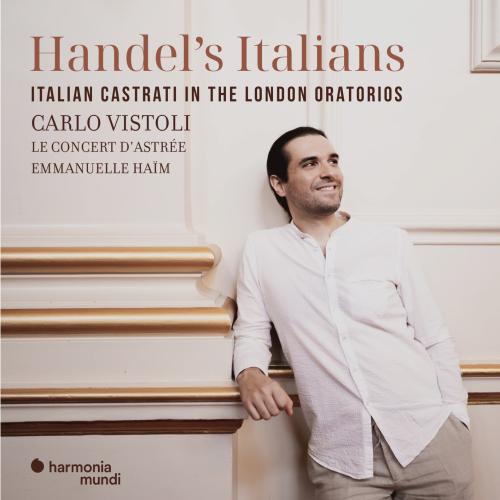
Handel's Italians: Italian Castrati in the London Oratorios Carlo Vistoli, Giulia Semenzato, Le Concert dAstrée & Emmanuelle Haïm
Album info
Album-Release:
2026
HRA-Release:
04.09.2026
Label: Harmonia Mundi
Genre: Classical
Subgenre: Vocal
Artist: Carlo Vistoli, Giulia Semenzato, Le Concert dAstrée & Emmanuelle Haïm
Composer: Georg Friedrich Händel (1685-1759)
Album including Album cover Booklet (PDF)
- George Frideric Handel (1685 - 1759): Concerto Grosso in D Minor, Op. 6 No. 10, HWV 328:
- 1 Handel: Concerto Grosso in D Minor, Op. 6 No. 10, HWV 328: I. Overture 03:34
- Esther, HWV 50b (1732 Version), Act II Scene 3:
- 2 Handel: Esther, HWV 50b (1732 Version), Act II Scene 3: Aria. How can I stay when Love invites (Ahasuerus) 03:15
- 3 Handel: Esther, HWV 50b (1732 Version), Act II Scene 3: Recitative. Who dares intrude into our presence (Ahasuerus, Esther) 01:02
- 4 Handel: Esther, HWV 50b (1732 Version), Act II Scene 3: Duet. Who calls my parting soul from death? (Ahasuerus, Esther) 02:50
- 5 Handel: Deborah, HWV 51 (1733 Version), Act I Scene 3: Recitative. I go where Heav'n and Duty call (Barak) 00:08
- 6 Handel: Deborah, HWV 51 (1733 Version), Act I Scene 3: Aria. All danger disdaining (Barak) 04:01
- Deborah, HWV 51 (1734 Version), Act I Scene 1:
- 7 Handel: Deborah, HWV 51 (1734 Version), Act I Scene 1: Aria. Più bella spoglia sarà fral (Barak) 02:19
- Deborah, HWV 51 (1733 Version), Act II Scene 2:
- 8 Handel: Deborah, HWV 51 (1733 Version), Act II Scene 2: Recitative. Great Prophetess, my soul's on fire (Barak) 00:22
- 9 Handel: Deborah, HWV 51 (1733 Version), Act II Scene 2: Aria. In the battle, fame pursuing (Barak) 06:11
- Belshazzar, HWV 61 (1751 Version), Act I Scene 2:
- 10 Handel: Belshazzar, HWV 61 (1751 Version), Act I Scene 2: Recitative. Can you then think it strange (Cyrus) 00:16
- 11 Handel: Belshazzar, HWV 61 (1751 Version), Act I Scene 2: Aria. Great God! Who yet but darkly known (Cyrus) 03:21
- Theodora, HWV 68 (1750 Version), Act I Scene 2:
- 12 Handel: Theodora, HWV 68 (1750 Version), Act I Scene 2: Recitative. Most cruel edict! (Didymus) 00:29
- 13 Handel: Theodora, HWV 68 (1750 Version), Act I Scene 2: Aria. The raptur'd soul defies the sword (Didymus) 08:29
- Theodora, HWV 68 (1750 Version), Act II Scene 6:
- 14 Handel: Theodora, HWV 68 (1750 Version), Act II Scene 6: Accompagnato, Recitative. Forbid it, Heav'n! (Didymus, Theodora) 01:12
- 15 Handel: Theodora, HWV 68 (1750 Version), Act II Scene 6: Duet. To thee, thou glorious son of worth (Didymus, Theodora) 04:50
- Saul, HWV 53 (1741 Version), Act III Scene 5:
- 16 Handel: Saul, HWV 53 (1741 Version), Act III Scene 5: Aria. Di Jonathan lo stral portò (David) 03:07
- Messiah, HWV 56 (1750 Version), Part I:
- 17 Handel: Messiah, HWV 56 (1750 Version), Part I: Aria. But who may abide the day of His coming? 04:42
- Athalia, HWV 52 (1735 Version), Act III Scene 1:
- 18 Handel: Athalia, HWV 52 (1735 Version), Act III Scene 1: Recitative. Chi ha la pietade e 'l zelo (Joad) 00:16
- 19 Handel: Athalia, HWV 52 (1735 Version), Act III Scene 1: Aria. Cor fedele spera sempre (Joad) 06:33
- Athalia, HWV 52 (1735 Version), Act III:
- 20 Handel: Athalia, HWV 52 (1735 Version), Act III: Recitative. Now, Josabeth, thy fears are o'er (Joad, Josabeth) 00:11
- 21 Handel: Athalia, HWV 52 (1735 Version), Act III: Aria. Angelico splendor (Joad) 06:13
Info for Handel's Italians: Italian Castrati in the London Oratorios
Once established in London, Handel devised a new kind of music drama that won over the English public and gave the operatic stage a new, modern aspect. Revolutionizing English traditions, he imported the drama and colour of Italy, and the voices of its greatest operatic castrati. Carlo Vistoli now presents this heritage, reviving some of the greatest Handel arias first sung in London by his illustrious compatriots.
Carlo Vistoli, countertenor
Giulia Semenzato, soprano
Le Concert d'Astrée
Emmanuelle Haïm, conductor
Carlo Vistoli
began his vocal training with William Matteuzzi and Sonia Prina in 2007 and made his stage debut with Dido & Aeneas in 2012. He received several awards in international singing competitions like the «Farinelli Prize» at the 2012 Città di Bologna Singing Competition or the First Prize at the 2013 «Renata Tebaldi» (Baroque Section) in San Marino.
Chosen for the 2015 edition of “Le Jardin de Voix”, led by William Christie, with whom he collaborates since then, highlights of his career include Giulio Cesare in Egitto by Handel in Shanghai, Dafne by Caldara in Venice, Agrippina by Handel in Brisbane (for which he receives a Helpmann Award), Erismena by Cavalli in Aix-en-Provence with Leonardo García Alarcón. In 2017, he took part to John Eliot Gardiner's project Monteverdi450, that toured internationally.
More recently, he was involved in productions like Vivaldi's Orlando furioso at La Fenice in Venice, Monteverdi's L'incoronazione di Poppea at the Salzburg Festival, Artaserse by Hasse in Sydney, La Finta pazza by Sacrati in Dijon with Alarcón, Orfeo ed Euridice by Gluck at the Rome Opera with Robert Carsen's staging, Semele by Handel with Gardiner in Paris, London, Milan (Teatro alla Scala). In 2021 he sang in three Handel works: Rinaldo in Losanna, Giulio Cesare in Egitto, debuting the title role, in Basel and Madrid, with Andrea Marcon, and he took part to La Rappresentatione di Anima et di Corpo at Theater an der Wien (with Antonini and Carsen). Moreover, he sang Pergolesi's Stabat Mater on tour with Cecilia Bartoli and Gianluca Capuano and he made its debut at Bolshoi Theatre in Moscow singing Polinesso in Handel's Ariodante in David Alden's production.
Highlights of the 2021/22 season are two new productions by Damiano Michieletto, Orfeo ed Euridice at Komische Oper Berlin and Giulio Cesare in Egitto at Thêatre des Champs-Elysées in Paris as Tolomeo, conducted by Philippe Jaroussky, in addition to Xerse by Cavalli at Festival della Valle d'Itria in Martina Franca, Ruggiero in Alcina by Händel alongside Cecilia Bartoli in Florence (with Capuano and Michieletto) and, for the first time, Nerone in L'incoronazione di Poppea at Staatsoper Berlin conducted by Jean-Christophe Spinosi, with whom he also sang the title role of Vivaldi's Orlando furioso in concert at Théâtre des Champs-Elysées in 2023. In the same year, he was at Festspielhaus Baden-Baden in Handel's Il trionfo del Tempo e del Disinganno with the Berliner Philharmoniker and Emmanuelle Haïm, in Alsace in the theater circuit of the Opéra du Rhin singing in L'incoronazione di Poppea, and he came back to Komische Oper Berlin in Semele.
In 2023/2024 season he returned to the Staatsoper Berlin to sing Farnace in Mozart's Mitridate, he was again Orfeo in Carsen's production in Valencia; he also sang the two title roles of Rinaldo and Giulio Cesare, the latter alongside Cecilia Bartoli, on European tour and at Théâtre des Champs-Elysées, and he made his debut at San Francisco Opera interpreting Arsace in Händel's Partenope in Christopher Alden's production, conducted by Christopher Moulds.Furthermore, he made his debut at the Wiener Staatsoper in Giulio Cesare in Egitto, in the title role, and in the season of the Teatro alla Scala in Milan, singing Alidoro for the first time in Cesti's Orontea, and at the Verdi Festival in Parma in Monteverdi's Il combattimento di Tancredi e Clorinda.
In 2025 he is back at the Rome Opera, as Ruggiero in Handel’sAlcina directed by Pierre Audi and conducted by Rinaldo Alessandrini, and at the Teatro alla Scala – in the world premiere of the new opera Il nome della rosa written by Francesco Filidei and conducted by Ingo Metzmacher with the direction of Michieletto – and he will make his debut at the London Royal Ballet and Opera Covent Garden in Handel’s Semele as Athamas (a show that also sees him involved at the TCE in Paris). He will also sing for the first time at the Innsbrucker Festwochen der Alten Musik and at the Bayreuth Baroque Opera Festival.
Carlo Vistoli was awarded the Premio “Franco Abbiati” from the Italian music critics (43rd edition) as best singer of 2023. He also won the 2024 “Jan Shrem and Maria Manetti Shrem Emerging Stars Competition” of the San Francisco Opera.
He recorded for Alpha, Brilliant, Erato, Harmonia Mundi, Ricercar, Soli Deo Gloria and other labels, and his three first solo recitals have been published by Arcana. His last solo CD, “Sacro furore”, recorded alongside Akademie für Alte Musik Berlin, is dedicated to sacred works by Vivaldi, and marks his new collaboration with the label Harmonia Mundi.
Emmanuelle Haïm
After studying the piano, harpsichord and organ, Emmanuelle Haïm (from France) chose orchestral conducting. In 2000, she founded Le Concert d’Astrée. She tours the world with this orchestra, which specialises in repertoire from the seventeenth and eighteenth centuries, regularly performing with celebrated singers such as Cecilia Bartoli, Philippe Jaroussky and Natalie Dessay. Haïm has worked with renowned directors such as Mariame Clément, Jean Bellorini, Robert Wilson and Guy Cassiers on numerous opera productions, including at Opéra de Lille, Staatsoper Berlin and the Paris Opera. Haïm regularly works with the Vienna Philharmonic, the New York Philharmonic, the London Symphony Orchestra and the Berliner Philharmoniker. After Giulio Cesare in 2022, she is returning to Dutch National Opera with her own Le Concert d’Astrée for Semele.
Le Concert d'Astrée
was founded in 2000 by conductor Emmanuelle Haïm, who brought together experienced musicians with a deep dedication to the authentic and expressive performance of early music. The ensemble quickly grew into one of the world’s leading baroque ensembles. It has accompanied performances of baroque operas at venues such as Staatsoper Berlin, Opéra national de Paris and the Glyndebourne Festival. Le Concert d’Astrée previously appeared at Dutch National Opera in George Frideric Handel’s Giulio Cesare. In the 2025 – 2026 season, the ensemble returns to accompany Handel’s Semele.
Booklet for Handel's Italians: Italian Castrati in the London Oratorios